

Community Nursing Referral Review Adelaide
A community nursing referral review Adelaide teams complete well can prevent a familiar problem: a participant’s health needs are becoming harder to manage at home, yet the referral contains too little clinical detail to establish what is required. The result can be delayed assessment, unclear responsibilities for support workers, and avoidable risk for the participant and everyone involved in their care.
For Support Coordinators, families, guardians and discharge teams, a nursing referral is more than an administrative step. It is the starting point for practical nursing assessments, a clear picture of risk, and care recommendations that can be put into daily routines. Where continence, wounds, stomas, catheters, diabetes, medication, skin integrity or bowel and bladder care are involved, nurse-led NDIS care brings the clinical judgement needed to assess the situation safely.
When a Community Nursing Referral Needs Review
A referral review is most useful when there has been a change in health status, current care arrangements are no longer working, or the team needs clinical evidence for an NDIS plan review or change of circumstances. It should not be treated as a crisis-only service. Earlier nursing input can identify risks while there is still time to make sensible adjustments.
Common triggers include recurrent skin tears, a wound that is slow to heal, redness over pressure areas, leaks or blockages with catheter equipment, increasing continence accidents, constipation or bowel routine concerns, medication errors, unstable blood glucose readings, or repeated presentations to hospital. Sometimes the concern is less obvious. A family member may be exhausted by a complex daily routine, or support workers may have different approaches to the same task. Those are signs that the participant may need clinical support in the home, a documented care plan, or support worker training and clinical oversight.
A referral also deserves review when the participant’s existing nursing documentation is old, too general, or no longer reflects their health needs. A plan stating that a person “requires assistance with continence” does not explain the assessment findings, skin risks, products, escalation steps or staff competencies required to provide safe care. Clear clinical detail protects dignity and gives the wider team a consistent way to respond.
What a Nurse-Led Referral Review Looks For
A nurse-led review starts by understanding the participant’s diagnosis, health history and usual routine, but it does not stop there. The practical question is what happens in the home every day. That includes the clinical task, the environment, the equipment or consumables in use, who is undertaking the task, what can go wrong, and what should happen when it does.
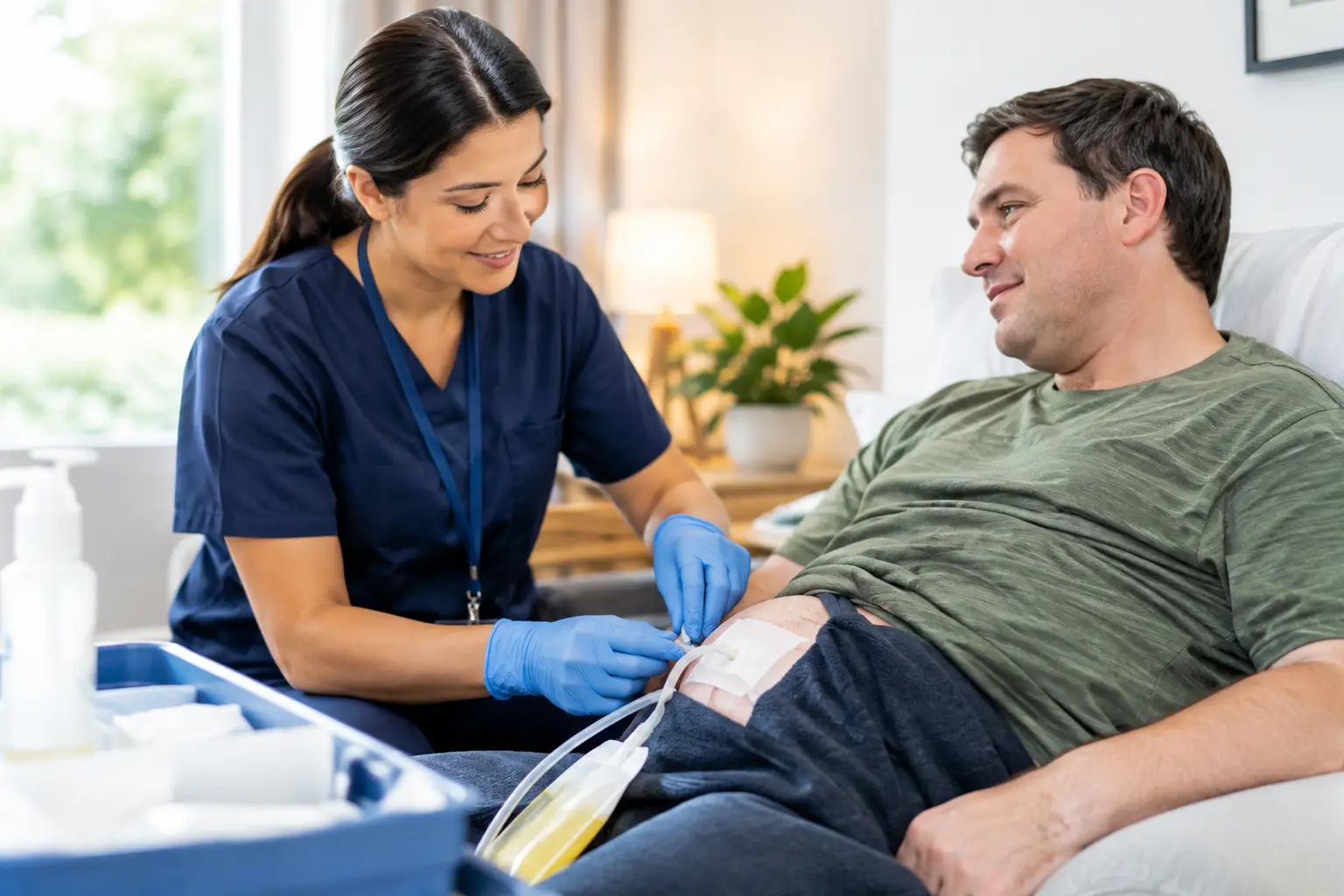
For example, a participant with a catheter may need more than routine assistance. The nursing assessment may need to consider the catheter type, drainage arrangement, frequency of blockage or leakage, hydration patterns, signs of infection, skin condition, mobility and whether workers understand when to escalate concerns. The right recommendation may include a care plan, a catheter support routine, competency-based training for the people delivering care, and a clear pathway for clinical review.
With wounds and pressure care, the review considers the wound history, current dressing regimen, infection indicators, pain, pressure redistribution, nutrition considerations where relevant, and whether the current routine can be maintained consistently. For bowel and bladder care, a nurse may assess patterns, triggers, products, fluid intake, constipation risk, skin breakdown and the practical reality of managing the routine with dignity.
This detail matters because complex health support is not made safe by a generic instruction sheet. It requires recommendations that fit the participant’s condition, their daily life and the skills of the people supporting them.
The difference between a task list and a clinical plan
A task list might say, “change dressing daily” or “monitor blood glucose”. A clinical plan explains the purpose of the task, the approved method, infection-control considerations, the signs of deterioration, required documentation and when the worker must contact a nurse or seek urgent medical assistance.
That distinction is especially important where high-intensity clinical supports are delivered by support workers. Training should be linked to the participant’s individual needs, not delivered as a one-size-fits-all session. Workers need to understand both the procedure and the limits of their role. Ongoing clinical oversight gives the team a way to check that care remains appropriate as the participant’s needs change.
Information That Makes a Referral More Useful
A referral does not need to be perfect before it is sent, but a small amount of relevant information allows the nurse to triage urgency and prepare for the assessment. The most useful referrals explain the immediate concern, the participant’s current diagnosis or medical history, and what has changed.
It also helps to include current treating team details, recent hospital discharge information where available, existing care plans, medication information relevant to the referral, recent incident patterns, photos of wounds only where consent and secure processes are in place, and the names of key people involved in care. For plan-related reports, it is helpful to outline what decision or review is approaching and what evidence is required.
Equally valuable is practical context. Is the participant receiving inconsistent care? Is a family member managing a demanding clinical routine without adequate guidance? Have support workers reported uncertainty with catheter, stoma, diabetes or medication-related tasks? Has the participant’s skin deteriorated because a pressure care routine is difficult to maintain? These details help identify whether assessment, a clinical care plan, training, regular nursing review, or a combination of supports is needed.
Consent must be clear before health information is shared or assessments are arranged. Where a guardian or nominee is involved, their role should be documented so communication is respectful, lawful and efficient.
Turning Assessment Findings Into Action
The value of a community nursing referral review is measured by what happens next. A strong assessment should lead to practical actions that reduce confusion rather than create another report that sits unread in a file.
Depending on the participant’s needs, this may include a continence assessment, wound or pressure care plan, catheter or stoma care guidance, diabetes support recommendations, medication support processes, bowel and bladder routines, or skin integrity monitoring. It may also identify the need for support worker training, regular nursing review, liaison with the treating medical team, or escalation where symptoms suggest urgent medical attention.
For Support Coordinators, clear reports for Support Coordinators can assist with planning conversations because they explain the clinical need, functional impact, identified risks and recommended nursing supports in plain, evidence-based language. A report should be specific about why the recommendation is needed and what could occur if the need is not addressed. It should not make assumptions about funding decisions, but it can provide the clinical evidence decision-makers need to understand the situation.
For families, a good plan creates reassurance without pretending that every risk can be removed. Complex care always involves some uncertainty. The aim is to establish safe routines, clear escalation points and reliable clinical review so concerns are recognised early.
Choosing the Right Time to Refer
It depends on the situation, but waiting for a serious incident is rarely the best threshold. Refer when a health-related routine is increasing in complexity, when staff confidence is low, when there are signs of deterioration, or when existing documentation no longer matches the participant’s care needs.
Urgent symptoms such as severe pain, rapidly spreading redness, significant bleeding, fever with infection concerns, sudden deterioration, catheter-related inability to pass urine, or acute changes in consciousness require prompt medical assessment. A community nursing referral should support ongoing care and clinical planning, not delay emergency or urgent medical treatment.
Compassion Wings provides nurse-led NDIS care across Adelaide for participants who need practical nursing assessments, clinical documentation and ongoing oversight for complex health needs. The focus is safe, dignity-focused care that works in the participant’s actual home routine, not generic advice that leaves families and workers guessing.
The most helpful referral is often the one made when a small concern first becomes a pattern. With the right clinical information, a nursing review can turn uncertainty into a workable plan and help participants stay safe at home.