




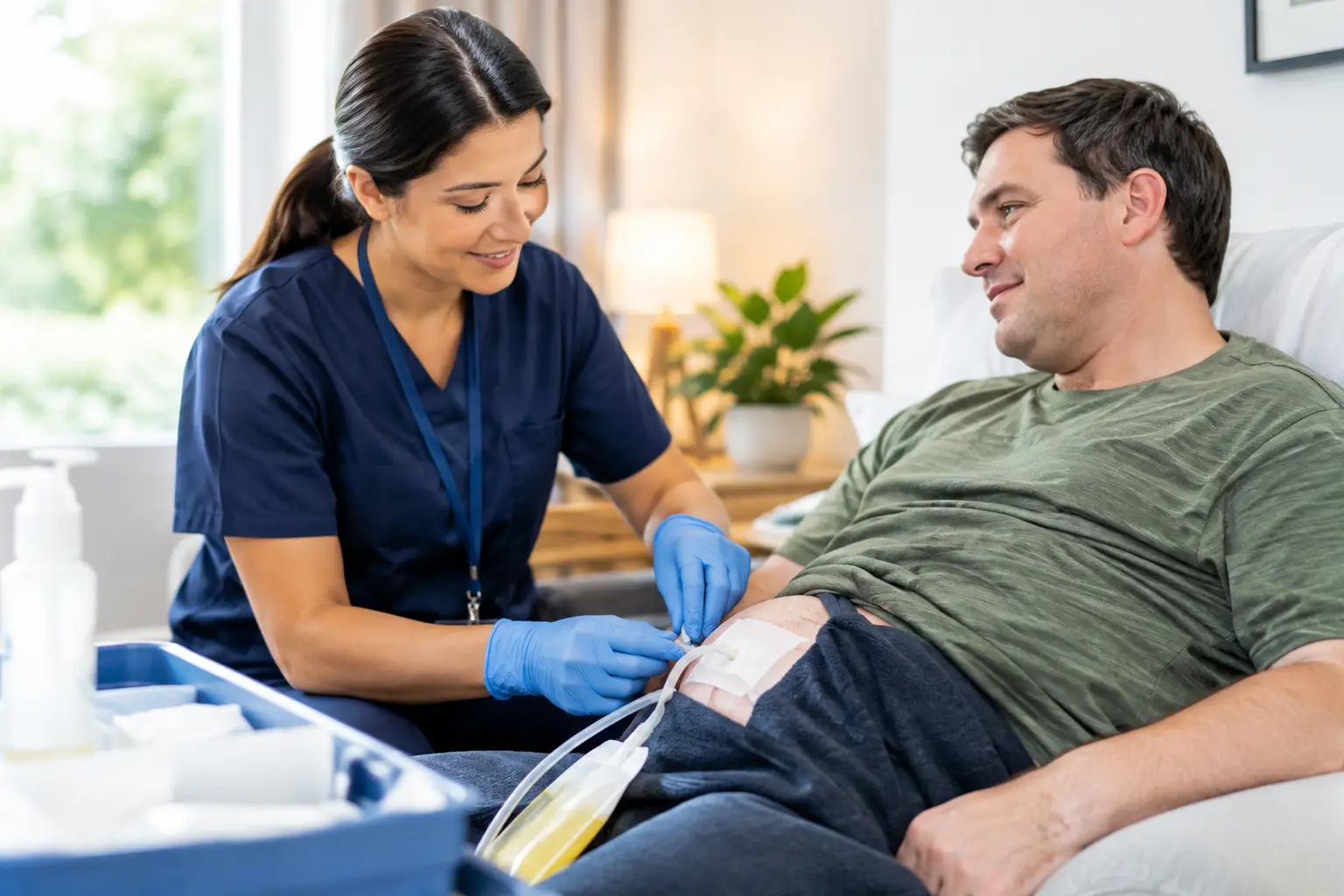
Catheter Care Nursing Salisbury for Complex Needs
A catheter routine can appear straightforward until it stops working as expected. Leakage, blockages, pain, repeated urinary tract infections, skin damage or uncertainty among support workers can quickly become a clinical risk. Catheter care nursing Salisbury gives NDIS participants, families and care teams access to practical nursing assessments, clear plans and ongoing oversight when bladder care is no longer safely managed by routine alone.
For a person with complex health needs, catheter support is not simply about emptying a drainage bag. It is about recognising changes early, protecting skin integrity, maintaining privacy and dignity, documenting concerns accurately, and knowing when escalation is needed. This is where nurse-led NDIS care can make a meaningful difference at home.
When catheter care needs nursing input
A catheter may be suprapubic, urethral or used intermittently. Each arrangement has different risks, routines and training requirements. The right level of nursing involvement depends on the participant’s diagnosis, catheter type, infection history, mobility, cognitive needs, hand function, skin condition and the experience of the people providing daily support.
Nursing input is particularly valuable when a participant has recurrent blockages, bypassing or leakage around the catheter, blood in the urine, ongoing discomfort, strong-smelling or cloudy urine, reduced output, frequent emergency department presentations or skin breakdown around a suprapubic site. A referral is also appropriate after discharge from hospital, when a catheter has been newly inserted, or when an existing routine is no longer working reliably.
For Support Coordinators, the issue is often not whether a participant has a catheter. It is whether there is enough clinical evidence to show what care is required, who can safely provide it, and what must happen if the person’s condition changes. Practical nursing assessments help answer those questions with a clear, participant-specific plan rather than assumptions or generic instructions.
What a catheter nursing assessment looks at
A thorough assessment starts with the participant’s lived experience. Nurses ask what is happening during the usual routine, what has changed, which issues are causing distress, and what the participant wants to be able to do safely. The assessment should respect privacy and choice while identifying clinical risks that may otherwise be missed.
The nurse will review the catheter type and management routine, the drainage system, fluid intake where relevant, bowel patterns, mobility, positioning, medications and infection history. Skin around the catheter site, securement and tubing position may also need review. For participants with a suprapubic catheter, the stoma site and surrounding skin require careful monitoring because moisture, friction and leakage can contribute to irritation and infection risk.
Bladder care cannot always be separated from bowel care. Constipation can affect catheter drainage and contribute to discomfort or leakage. Reduced mobility, diabetes, neurological conditions and pressure injury risk can also complicate the picture. A useful clinical assessment considers these connected factors rather than treating a blocked catheter or wet clothing as an isolated event.
This assessment can result in a clinical care plan that sets out the everyday routine, supplies and hygiene expectations, warning signs, escalation steps and the responsibilities of nurses, participants and trained support workers. The plan should be clear enough to use during a busy shift but detailed enough to support safe, consistent care.
Safe, dignity-focused catheter support at home
Safe catheter care is built on consistency. Small variations in hand hygiene, tubing placement, bag positioning, documentation or response to symptoms can create problems over time. The goal is not to over-medicalise a participant’s home. It is to provide clinical support in the home that protects health while keeping routines practical and respectful.
Privacy matters at every stage. Catheter care may feel deeply personal, particularly for participants who rely on others for assistance. Care should be explained before it begins, undertaken with consent, and arranged around the person’s preferences wherever possible. This includes respecting how and when they wish to discuss bladder management, who they are comfortable receiving care from, and how information is shared with family or their wider team.
Daily observations are useful when they have a purpose. Support workers do not need to make clinical diagnoses, but they should know what is normal for that individual and what needs to be reported. Changes in output, colour, leakage, pain, fever, confusion, site redness or swelling may require prompt nursing review or medical escalation depending on the symptoms and the person’s health history.
A catheter that is not draining, a participant with severe pain, fever or chills, new confusion, significant bleeding, a catheter that has fallen out, or signs of acute illness should be treated as an urgent clinical concern. The appropriate response depends on the care plan and severity of symptoms, but delays can lead to avoidable harm. Clear escalation instructions give staff and families confidence during stressful situations.
Training support workers for high-intensity care
Where trained support workers are involved in catheter-related tasks, education should be tailored to the participant and the actual duties they perform. Generic training alone may not address the practical risks of a specific catheter type, a challenging transfer routine, a suprapubic site with fragile skin or a person who cannot easily communicate discomfort.
Support worker training and clinical oversight can cover infection prevention, drainage bag management, catheter positioning, observations, documentation, privacy and when to contact a nurse. Training may also include how to follow the individual clinical care plan, rather than relying on memory or informal handovers.
Competency is not just a one-off checklist. Staff changes, a hospital admission, a new catheter regime or a decline in the participant’s health may mean the plan and training need review. Ongoing oversight helps ensure the care delivered in the home continues to reflect the participant’s current clinical needs.
Documentation that supports safer NDIS care
Good catheter documentation is both practical and protective. It provides a reliable record of what has occurred, helps identify emerging patterns and gives clinicians the information needed to respond appropriately. It also supports continuity when several workers or providers are involved.
For example, repeated notes about leakage during particular times of day, reduced output after constipation, recurring skin irritation, or multiple unplanned call-outs may indicate a problem with the current routine. Without clear records, these patterns can be dismissed as isolated incidents. With appropriate nursing review, they can inform changes to care, medical follow-up or further clinical evidence.
For Support Coordinators and Plan Managers, clear reports for Support Coordinators can explain the participant’s catheter-related support needs in plain, clinically grounded language. A report may outline risks, required nursing input, worker training needs, the impact of changes in health, and why consistent oversight is necessary to help the participant remain safe at home. This is particularly helpful for plan reviews or a change of circumstances where informal accounts alone may not show the full level of risk.
Documentation should be factual, current and specific to the person. Statements such as “requires catheter care” are rarely enough. A stronger clinical record describes the catheter type where known, the care tasks involved, observed risks, frequency of issues, response requirements and the consequences if support is unavailable or inconsistent.
Making a referral for catheter-related nursing support
The most useful referrals include the participant’s contact details and consent arrangements, current diagnosis or discharge information, catheter type if known, recent concerns, existing clinical plans and the names of other involved health professionals. It also helps to know whether support workers are currently completing catheter-related tasks and where the team is uncertain.
A referral does not need to contain every detail before a nurse can begin. What matters is identifying the immediate concern and acting before recurring issues become a crisis. A nurse can assess current routines, speak with the participant and care team, clarify clinical priorities and recommend a practical next step.
In Salisbury and across Adelaide, Compassion Wings provides nurse-led NDIS care for participants whose catheter and bladder care needs require more than a standard support routine. The focus is safe, dignity-focused care: practical assessment, individualised clinical plans, support worker education and documentation that stands up to scrutiny.
When a catheter routine begins to create uncertainty, repeated incidents or concern for a participant’s wellbeing, early nursing input can turn scattered observations into a safer, more reliable plan for care at home.