

Diabetes Support at Home NDIS Guide
A blood glucose reading that is suddenly far too high, repeated hypos overnight, insulin being given at inconsistent times, or support workers unsure what to document – these are the moments when diabetes support at home NDIS becomes more than routine care. For many participants, diabetes management is not just about diet or medication. It is a clinical safety issue that affects skin integrity, wound healing, cognition, infection risk and the ability to remain safely at home.
For Support Coordinators, families and SIL teams, the challenge is usually not recognising that diabetes matters. It is knowing when standard supports are no longer enough, what can reasonably be managed in the home, and when nurse-led NDIS care is needed to reduce risk and bring structure back into daily routines.
What diabetes support at home NDIS can involve
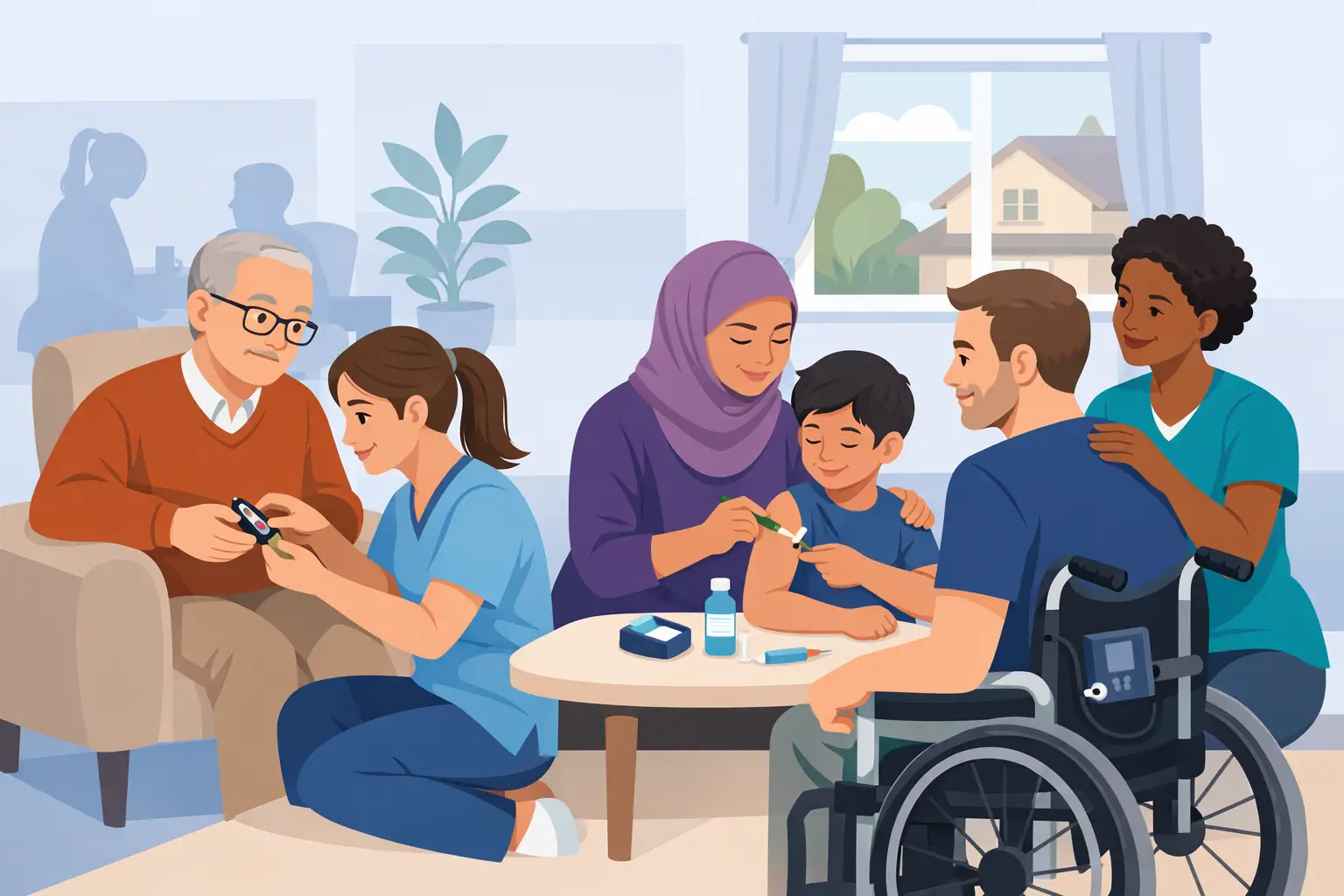
In the NDIS setting, diabetes support at home may include more than reminder prompts or general supervision. Participants with complex health needs often need clinical support in the home that is built around safe routines, practical nursing assessments and clear escalation pathways.
That can include assessment of how diabetes is currently being managed, review of blood glucose monitoring routines, insulin or medication oversight where appropriate, checking whether support workers understand the care plan, and identifying risks that are increasing the chance of hospital presentation. A participant may also need monitoring of skin integrity, pressure areas, wound healing or infection concerns that are made worse by poorly controlled diabetes.
The right level of support depends on the participant. Some people mainly need a nurse to assess, document and train the team around them. Others need ongoing clinical oversight because their diabetes management is closely linked to other high-intensity supports, reduced cognition, complex medication routines or reduced ability to recognise symptoms.
When a nursing referral makes sense
A nursing referral is usually worth considering when diabetes care is inconsistent, unsafe or poorly documented. This is especially true if different workers are doing things differently, if the participant has frequent hypo or hyper episodes, or if there are concerns about wounds, falls, confusion, continence issues or repeated infections.
It also makes sense when a participant is transitioning home from hospital, starting with a new provider, or experiencing a change of circumstances that has made existing supports inadequate. In these situations, families and coordinators often need more than reassurance. They need a clinician who can assess the current risks, clarify what daily care should look like, and provide documentation that stands up to review.
A practical nursing assessment can help answer questions such as whether the participant understands their diabetes routine, whether the support team can safely assist, whether monitoring is being completed properly, and whether there are signs of deterioration that need medical follow-up.
Common signs the current setup is not working
One of the clearest signs is variation. If one worker records blood glucose but another forgets, if insulin timing shifts depending on the roster, or if nobody is sure what to do when readings fall outside the expected range, the issue is not only inconsistency. It is clinical risk.
Another sign is when diabetes starts affecting other parts of the participant’s health. Slow wound healing, skin breakdown, reduced appetite, increased fatigue, recurrent urinary issues and confusion can all complicate daily care. In participants with mobility limitations or pressure care needs, diabetes can quickly turn a manageable issue into a more serious one.
Why nurse-led assessment matters in diabetes care
Diabetes is often discussed as though it sits in its own category. In home-based disability supports, that is rarely the case. It overlaps with medication management, continence, skin care, infection prevention, meal timing, cognition and support worker capability.
That is why nurse-led NDIS care adds value. A nurse does not only look at the glucose reading itself. They assess the full clinical picture – what the participant can do independently, what others are doing on their behalf, what risks are present in the home, and what needs to be documented so care is safe and consistent.
This is particularly important for participants with communication barriers, acquired brain injury, intellectual disability, mental health complexity, frailty or multiple chronic conditions. The question is not simply whether diabetes exists. It is whether the current support arrangement is clinically safe.
Building safe diabetes routines at home
Most diabetes-related issues in the home come back to routine. Not rigid routine for its own sake, but a realistic plan that the participant and support team can actually follow.
That means having clear instructions about monitoring times, medications or insulin administration requirements, signs and symptoms that require action, what to do if a reading is outside the expected range, and when to contact a nurse, GP or emergency service. It also means documenting what happened, not relying on verbal handover that can be forgotten by the next shift.
Safe, dignity-focused care also matters here. Diabetes support should not feel like constant surveillance or criticism. The participant’s preferences, usual habits and understanding of their own condition need to be respected. Sometimes the most effective clinical plan is not the most complicated one, but the one that can be followed reliably in real life.
The role of support worker training and clinical oversight
Many support workers are capable and committed, but diabetes support can become unsafe when training is informal or assumptions are made. A worker may know the participant well and still be unclear about when to escalate a low reading, how to document concerns, or how diabetes affects wound risk and infection.
Support worker training and clinical oversight can make a substantial difference. It helps create consistency across the roster, reduces guesswork and gives teams confidence about what sits within the care plan. It also protects the participant from the very common problem of important clinical tasks drifting over time.
For Support Coordinators and SIL providers, this is often where a nurse-led service is most useful. The goal is not to replace the wider team, but to strengthen it with clear direction, practical education and reliable follow-up.
Documentation matters more than many teams expect
If diabetes support in the home is complex, poor documentation creates problems quickly. Families may feel something is wrong but cannot show the pattern clearly. Support Coordinators may suspect additional clinical input is needed but have limited evidence for a review. Workers may escalate concerns verbally but leave no reliable record.
Clear reports for Support Coordinators are not paperwork for its own sake. They provide evidence of current risks, the participant’s functional and clinical needs, and the type of nursing input required to support safe care at home. Good documentation can also support plan reviews or change of circumstances processes when health needs have become more complex.
Strong clinical reporting usually captures what the participant is experiencing day to day, what risks have been identified, what oversight or training is required, and what recommendations are reasonable within the NDIS context. That kind of evidence is far more useful than general statements that the participant “needs more support”.
What to have ready before referring for diabetes support at home NDIS
A referral is smoother when the clinical picture is clear from the start. It helps to gather recent hospital discharge information if relevant, a current medication list, details of blood glucose monitoring routines, any known hypo or hyper episodes, wound or skin concerns, and information about who currently provides day-to-day support.
It is also helpful to explain what is not working. For example, are workers unsure about the care routine, are readings fluctuating, is the participant declining support, or has a recent health change affected their usual management? That practical context helps a nurse identify priorities quickly.
In Adelaide, where participants may be supported across private homes, SIL environments and community settings, fast and clear communication between the coordinator, family and clinical team can prevent delays and reduce risk.
The bigger picture – helping participants stay safe at home
Well-managed diabetes care in the NDIS is not only about blood sugar. It is about reducing avoidable complications, preserving dignity and helping participants stay safe at home with support that is clinically appropriate.
Sometimes that means a one-off nursing assessment and a clearer care plan. Sometimes it means ongoing complex health support, support worker education and regular review because the risks are changing. There is no one-size-fits-all answer, and that is exactly why clinical judgement matters.
A nurse-led provider such as Compassion Wings can bring that practical layer of assessment, documentation and oversight that families and coordinators often need when diabetes care has become harder to manage. The most helpful next step is usually not waiting for things to unravel further, but getting the right clinical eyes on the situation early.




1 Comment
Can Nurses Train Support Workers Safely? - Compassion Wings
July 4, 2026[…] is not the same as clinical competence. When care involves a catheter, bowel routine, stoma, wound, diabetes support or pressure area risk, the question becomes very practical: can nurses train support workers in a […]