
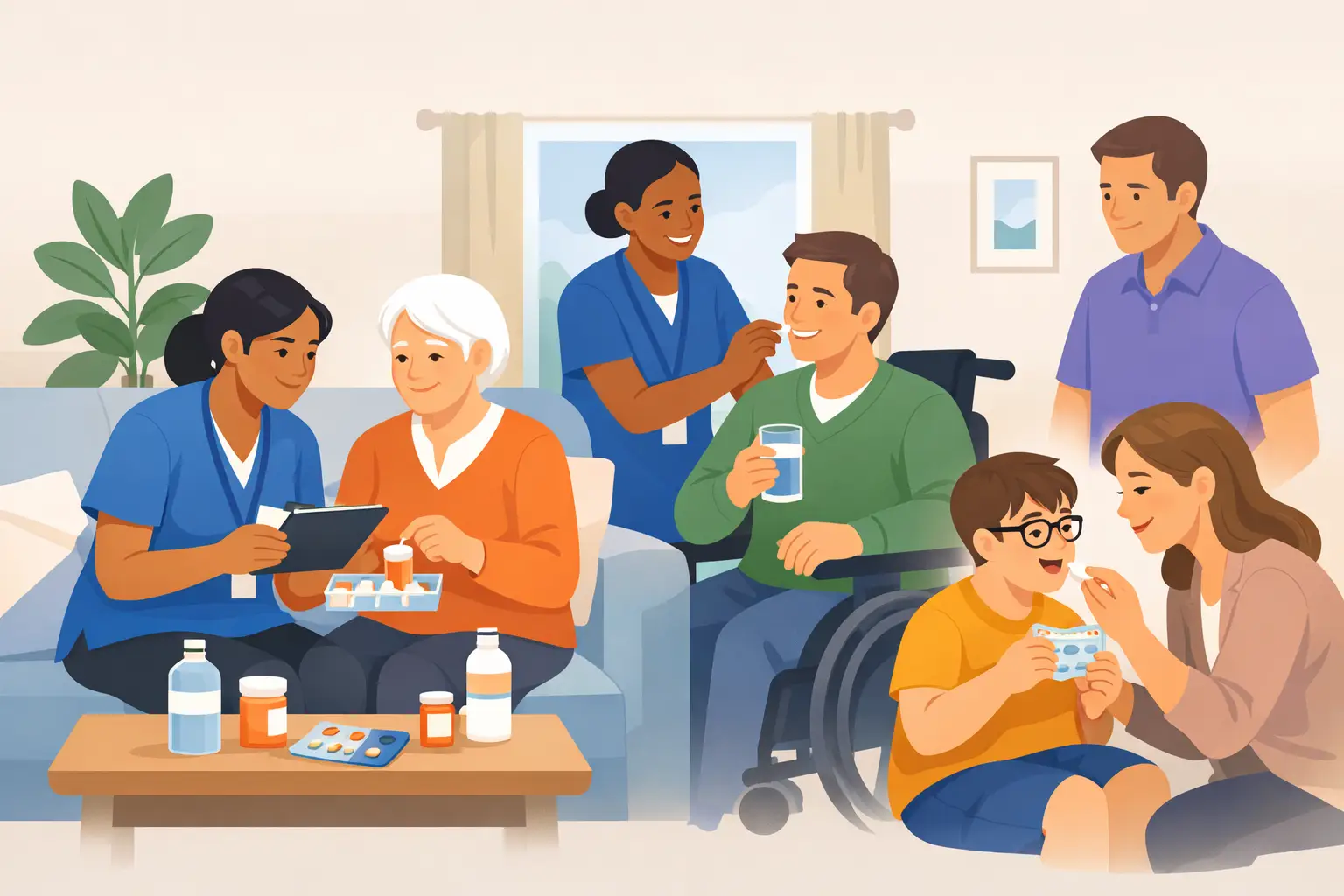
Medication Administration NDIS Explained
A missed dose can be inconvenient. The wrong dose, poor timing, or unclear instructions can quickly become a clinical risk. That is why medication administration NDIS support needs more than a task-based approach. For participants with complex health needs, it often requires nurse-led assessment, clear delegation, careful documentation, and ongoing oversight to keep care safe at home.
For Support Coordinators, families and SIL providers, medication support can sit in a grey area until something goes wrong. A participant may have multiple prescribers, frequent medicine changes, swallowing concerns, diabetes, a catheter, stoma, bowel routine, or skin integrity issues that make day-to-day medication support more complex than it first appears. In those situations, practical nursing input helps reduce avoidable hospital presentations and gives everyone clearer direction.
What medication administration NDIS support usually involves
Medication administration under the NDIS is not just about handing over tablets. It can include assessing how medicines are stored, checking whether support workers understand the prescription and administration method, identifying risks around missed doses or side effects, and setting up safe care routines in the home.
For some participants, support may be straightforward and limited to prompting or assistance with self-administration. For others, there may be a need for a nurse to assess the participant’s health status, review the medication regimen, develop a clinical care plan, and provide support worker training and clinical oversight. That difference matters. When complexity is high, a generic support model is rarely enough.
Medication administration also intersects with other areas of clinical care. A participant taking insulin may need diabetes support and monitoring. Someone with recurrent infections may need medication oversight alongside catheter care or wound care. A person with swallowing difficulty may need a review of how medicines are given, not just whether they are given.
When medication administration NDIS needs nurse-led oversight
The need for nursing involvement depends on the participant’s risks, not just the number of medications. A person on one medicine can still have high clinical needs if timing is critical, side effects are serious, or administration requires judgement. Equally, someone on several regular medications may be stable with the right systems in place.
Nurse-led NDIS care is often appropriate when there are frequent medication changes, multiple prescribers, recent discharge from hospital, PRN medications that need clear escalation pathways, or a history of medication errors. It is also important where the participant cannot reliably communicate symptoms, has dysphagia, has diabetes requiring insulin support, or needs medicines administered via a more complex route.
Another common reason for referral is uncertainty within the support team. If support workers are unsure what they can safely do, if families are carrying all the risk informally, or if a SIL provider is worried about compliance and documentation, that is a sign that practical nursing assessments may be needed. Good systems should not depend on guesswork or verbal handover alone.
Why documentation matters as much as the medicine itself
Medication support is one of the clearest areas where poor documentation creates avoidable risk. If the medication chart is outdated, if dose changes are passed on casually by text message, or if staff do not record refusals and incidents properly, the participant is exposed to harm and the provider is left without a safe clinical record.
Clear reports for Support Coordinators and providers can make a significant difference. A nurse-led review can identify what is currently happening, where the risks sit, and what needs to change to make medication support safer. That may include updated clinical care plans, medication administration procedures, escalation instructions, incident response guidance, and competency-based support worker training.
Good documentation is also valuable for plan reviews and change of circumstances. Where medication support is becoming more complex, nursing evidence helps explain why additional clinical oversight, training, or higher-intensity supports may be required. The strongest evidence is practical and specific. It should describe the participant’s actual risks, the level of support required, what has already been tried, and what could happen without the right care in place.
Medication administration NDIS and support worker training
Not every medication issue requires a nurse to attend every dose. Often, the safer and more sustainable approach is a combination of assessment, planning, and support worker education. Support worker training and clinical oversight can improve consistency across shifts and reduce confusion when participants have detailed routines or changing health needs.
Training should be tailored to the participant rather than delivered as a generic session. A worker supporting someone with epilepsy and PRN medication needs different knowledge from a worker supporting a person with insulin, topical wound treatments, or bowel-related medications. The purpose is not simply to tick off a competency. It is to make sure workers understand what they are doing, what to watch for, and when to escalate.
This is especially important in shared support environments or where there is high staff turnover. Systems need to be strong enough that safe care continues even when the regular worker is away. Practical nursing assessments, clear instructions and documented oversight create a much safer base than relying on one experienced staff member to carry the whole routine from memory.
Common risks that are easy to miss
Some medication risks are obvious, such as giving the wrong medicine or missing a critical dose. Others are quieter and often build up over time. A participant may become constipated because bowel medications are given inconsistently. Skin breakdown may worsen because pain relief is poorly timed and the participant avoids pressure care. Blood glucose levels may fluctuate because insulin support is not matched properly to meals or illness.
Storage and administration method also matter. Medicines may be left in unsuitable conditions, mixed up with ceased medications, or administered in a way that is inconsistent with the prescription. Participants who have vision changes, cognitive impairment, fatigue or hand weakness may appear independent with medication until a closer review shows repeated errors or near misses.
Refusal is another area that needs careful handling. A participant has the right to make choices, but repeated refusal of important medicines should trigger clinical review rather than frustration or informal workarounds. Safe, dignity-focused care means understanding why the refusal is happening and documenting a plan for what staff should do next.
What Support Coordinators and families should gather before referral
A referral is usually more effective when the basic clinical picture is clear from the start. That includes the current medication list, recent hospital discharge paperwork if relevant, details of who is currently supporting the participant, and any known concerns such as missed doses, refusals, incidents, swallowing issues, side effects, or frequent changes ordered by prescribers.
It also helps to know where the pressure points are. Is the family managing because no one else feels confident? Are support workers unclear on scope and escalation? Is the participant’s health becoming less stable? Is documentation not standing up to scrutiny? These details help a nurse identify whether the main need is assessment, care planning, direct clinical support, worker education, or a combination of all four.
For Adelaide referrers, timely nursing input can be particularly useful when a participant is transitioning home from hospital or when a provider needs a clear, clinically defensible plan quickly. In that setting, experienced nurse-led services such as Compassion Wings can bridge the gap between discharge instructions and safe day-to-day implementation in the home.
Medication administration NDIS is rarely one-size-fits-all
The right support depends on the participant’s health complexity, their capacity, the experience of the support team, and how stable the medication routine really is. Some people need a light-touch review and better systems. Others need ongoing nursing involvement because the risks are active and changing.
What should stay consistent is the standard of care. Medication support should be clinically sound, clearly documented, dignity-focused and practical enough to work on an ordinary Tuesday morning, not just on paper. That means looking beyond the chart and understanding the person, the environment, and the team around them.
When medication routines are unsettled, confusion tends to spread quickly across families, workers and services. A calm, nurse-led assessment can bring that back into focus. It gives participants safer care, gives support teams clearer direction, and helps everyone move forward with more confidence at home.
If medication support feels more complicated than it should, that instinct is often worth listening to. The earlier clinical risks are assessed and documented properly, the easier it is to build a routine that is safe, workable and sustainable.