
How NDIS Coordinators Arrange Home Nursing for Stoma Care
A leaking pouch at 7 am, sore skin around the stoma, or a support worker unsure whether a change is safe can quickly turn a manageable routine into a clinical risk. Understanding how NDIS coordinators arrange home nursing for stoma care helps prevent delays, gives families a clear pathway, and ensures the participant receives care that protects both health and dignity.
Stoma care is not simply a personal-care task. For some participants, it involves complex health support: monitoring output, protecting fragile skin, managing frequent leaks, responding to signs of infection or blockage, and ensuring support workers follow a safe routine. A nurse-led assessment establishes what is required, who can safely perform each part of the routine, and what needs urgent escalation.
When a Support Coordinator should arrange stoma nursing
A referral for clinical support in the home is appropriate when a participant has a new stoma, changing stoma needs, recurring pouch leaks, peristomal skin damage, high-output stoma concerns, or a hospital discharge that has left the household without a practical care routine. Nursing input is also valuable where family members are carrying complex care alone, multiple support workers are involved, or there is uncertainty about safe task allocation.
The referral does not need to wait for a crisis. Early practical nursing assessments can identify small issues before they become painful skin breakdown, dehydration, missed supports, or an avoidable hospital presentation. They can also clarify whether a concern requires clinical review by the participant’s GP, specialist stoma nurse, treating team or emergency service.
For Support Coordinators, the key question is not simply whether someone needs help changing a pouch. It is whether the person’s health needs, care environment and support team require clinical assessment, a documented plan, training, or ongoing nursing oversight.
How NDIS coordinators arrange home nursing for stoma care
The process usually begins with a focused referral and a conversation about the participant’s current routine. A coordinator can share relevant information such as the stoma type, recent discharge details, current concerns, treating clinicians, existing care plans, communication needs, support roster, consent arrangements and any immediate risks. Clear information at the outset helps the nurse prioritise the right assessment.
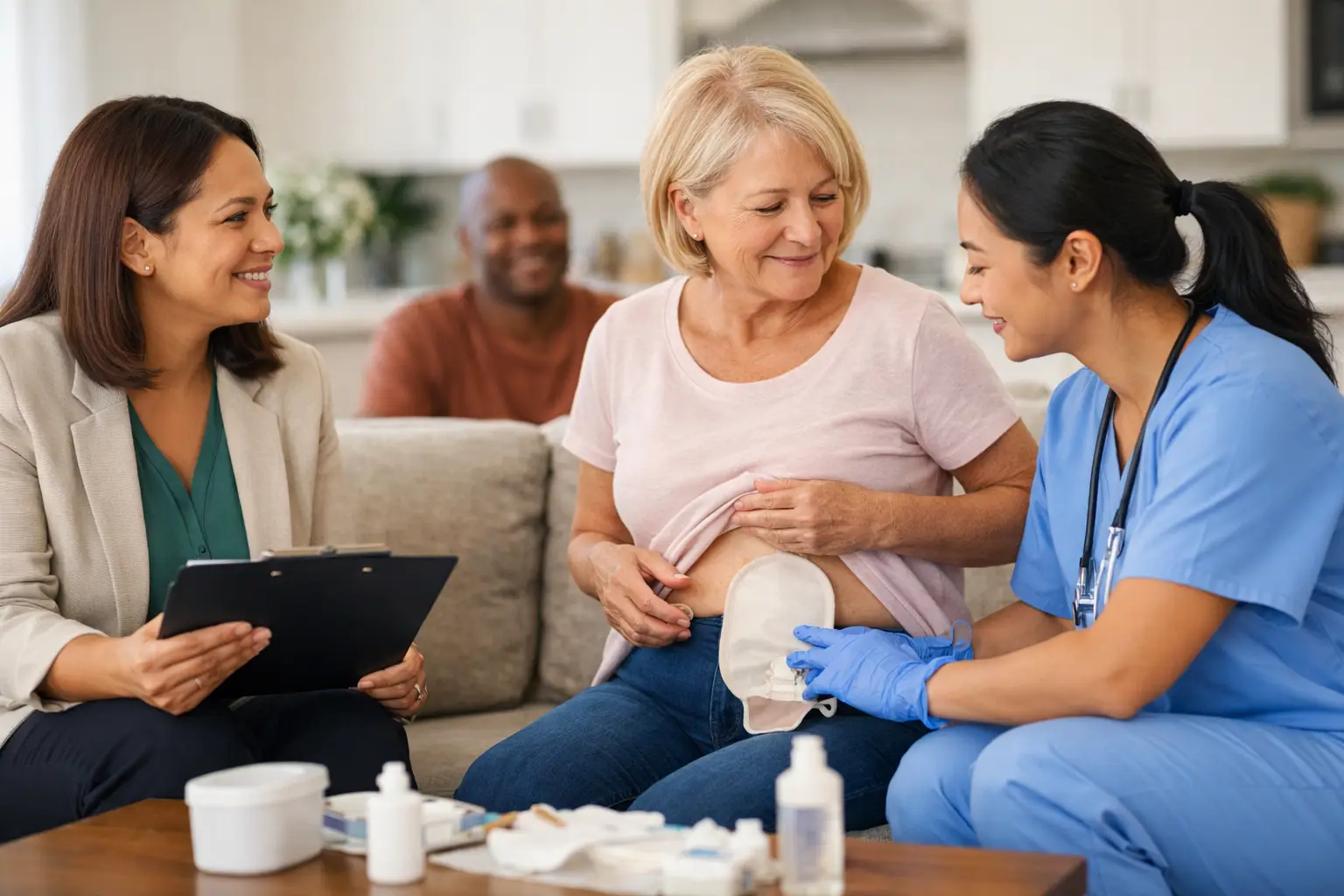
A nurse-led NDIS provider will then arrange an assessment in the home or another suitable community setting. This matters because stoma care is influenced by the real environment: where supplies are stored, whether the bathroom setup supports hygiene, how the participant prefers care to be delivered, and whether workers have the time and confidence to follow the routine correctly.
The assessment should be respectful and dignity-focused. The nurse will discuss the participant’s usual stoma routine, observe concerns where consent is provided, review the skin and surrounding area as clinically appropriate, identify risks, and consider the practical barriers that may be causing leaks or inconsistent care. The goal is not to replace the treating medical team. It is to translate clinical needs into safe day-to-day support at home.
Assessment findings guide the right level of support
Some participants need a one-off nursing assessment and a clear plan for their existing team. Others need a period of nursing visits while skin integrity settles, routines are established after discharge, or workers become competent with a high-intensity task. The appropriate approach depends on the participant’s condition, the complexity of the stoma, the stability of their health, and the capability of the people providing daily support.
A competent nurse will also recognise the limits of NDIS-funded clinical support. Acute illness, suspected obstruction, severe bleeding, sudden changes in output, significant dehydration, fever, escalating pain or rapidly worsening skin concerns may need urgent medical review. Clear escalation pathways prevent the home-care team from trying to manage beyond its scope.
What a practical stoma care plan should cover
A clinical care plan turns nursing assessment into a routine that can be followed consistently. It should use plain language while remaining detailed enough for workers, families and other clinicians to understand what safe care looks like.
For stoma care, the plan may describe the participant’s usual pouching system and routine, hygiene requirements, skin-protection measures, supply storage, disposal process, signs that require nursing review, and urgent escalation actions. It should also identify what the participant can do independently, what they want assistance with, and how privacy, communication and cultural preferences will be respected.
The plan should not be treated as a document that sits in a folder. Stoma needs can change with weight fluctuations, medication changes, illness, skin problems, hospital admissions or a different pouching product. Regular review is particularly helpful after a new discharge, a sequence of leaks, or any decline in skin condition.
Training support workers safely
Support worker training and clinical oversight are often the difference between a care plan that looks good on paper and one that works during an early-morning routine. Training should be specific to the participant’s plan rather than a generic demonstration.
The nurse can teach workers the required steps, infection-control practices, safe handling of supplies, documentation expectations and the boundaries of their role. Workers need to know what is normal for that participant and what is not. For example, a small, expected change during a routine may be managed according to the plan, while a new colour change, persistent bleeding, severe skin irritation or unusual output needs escalation.
Competency assessment is especially relevant where workers are expected to assist with high-intensity clinical supports. It gives providers and coordinators evidence that training has occurred and identifies where further supervision or refresher education is needed. Just as importantly, it gives workers permission to speak up when a task falls outside their training or the participant’s documented plan.
Documentation that supports coordinated care
Support Coordinators are often managing information from hospitals, GPs, allied health professionals, families, providers and plan managers at once. Clear reports for Support Coordinators reduce guesswork and make it easier to coordinate the next step.
A useful nursing report should outline the clinical issue, assessment findings, functional impact, identified risks, recommendations, support worker training provided, and the need for review or ongoing oversight. It should be factual, practical and linked to the participant’s day-to-day support needs rather than making broad assumptions about funding.
Where circumstances have changed, nursing evidence can help explain why existing arrangements are no longer safe or sufficient. For example, recurring skin breakdown, a higher level of care after surgery, or increasing reliance on trained workers may demonstrate a genuine change in clinical support needs. Decisions about funding remain with the NDIA, but well-prepared clinical evidence helps coordinators present the participant’s circumstances clearly.
Keeping families and clinical teams connected
Families often know the participant’s stoma routine better than anyone, yet may be exhausted by constant troubleshooting. Good home nursing includes listening to their observations, checking that recommendations are realistic, and ensuring they know who to contact when concerns arise.
With consent, the nurse can communicate relevant findings to the Support Coordinator and work alongside the participant’s treating team. This is particularly useful after hospital discharge, when instructions may be brief and the household is adjusting to a new routine. It also helps avoid conflicting advice between family, workers and clinicians.
For Adelaide participants with complex needs, Compassion Wings provides nurse-led NDIS care that can assess stoma-related risks, develop practical clinical care plans, train support workers and provide documentation that supports coordinated decision-making. The focus is safe, dignity-focused care that helps participants stay safe at home.
A well-timed nursing referral gives everyone a clearer role: the participant retains choice and privacy, families are not left to manage clinical uncertainty alone, workers understand their responsibilities, and Support Coordinators have reliable clinical information to act on. When stoma care changes, arranging nursing input early is often the most practical way to restore a safe routine.