

10 Best Wound Documentation Tips for Safer Care
A wound record can look complete and still fail the person receiving care. Notes such as “wound redressed, looks better” do not show what was assessed, whether the wound is healing, what risks were identified, or when the care team should escalate. The best wound documentation tips focus on creating a clear clinical story that another nurse, support worker, GP or Support Coordinator can understand without guessing.
For NDIS participants with complex health needs, good records protect dignity as well as safety. They help keep wound routines consistent across home visits, support worker shifts and clinical reviews, while providing practical evidence when a participant’s needs change.
Why wound documentation needs more than a dressing note
Wound care documentation is not simply proof that a dressing was changed. It records the wound’s condition at a point in time, the treatment provided, the participant’s response and the plan for what happens next. When those details are missing, early signs of deterioration can be overlooked and staff may unintentionally use inconsistent techniques or products.
This matters particularly where a participant has reduced mobility, diabetes, continence-related skin exposure, poor circulation, impaired sensation or a history of pressure injuries. A small change in exudate, pain or surrounding skin can be clinically significant. Clear records allow trends to be recognised early rather than relying on memory or handover comments.
For Support Coordinators and families, quality nursing documentation also clarifies why clinical input, wound supplies, monitoring or support worker training may be required. It turns a vague concern into useful, evidence-based information.
10 best wound documentation tips for clinical continuity
1. Start with a clear wound identification and baseline
Each wound needs an unambiguous description. Record its location using appropriate anatomical terms and, where relevant, state whether it is a pressure injury, surgical wound, skin tear, traumatic wound, diabetic foot ulcer or another wound type. If the cause has not been confirmed, document the known facts rather than making assumptions.
A baseline assessment should establish what the wound looked like when nursing care began. This gives the care team a reference point for healing or deterioration. If there are multiple wounds, label them consistently in every note, such as “left lateral lower leg wound” or “sacral pressure injury”.
2. Measure consistently, using the same method
Record length, width and depth in centimetres, using the same measurement approach at each formal review. Length and width alone may not reflect a deep cavity or undermining, so include depth where it is clinically relevant. If there is undermining or tunnelling, document its location using the clock-face method, along with the measured distance.
Measurements are most useful when they can be compared. A wound measured differently from one visit to the next can appear to change when the difference is only in the recording method. Where the wound is difficult to measure safely or the participant cannot tolerate the assessment, document this and explain what was observed instead.
3. Describe the wound bed, not just its size
The wound bed shows whether healing is progressing. Use clear, recognised terms such as granulation tissue, epithelial tissue, slough, necrotic tissue or exposed structures where clinically applicable. Avoid vague descriptions like “healthy” or “not good” unless they are supported by observable details.
Include the approximate proportion of each tissue type when practical. For example, a note may record predominantly red granulation tissue with a small area of yellow slough. This gives the next clinician far more useful information than a general statement that the wound is improving.
4. Record exudate, odour and bleeding objectively
Document the amount of exudate as none, scant, small, moderate or large, and describe its character, such as serous, sanguineous, serosanguineous or purulent. Note whether exudate is contained by the dressing or leaking onto clothing or bedding, as this can affect dressing selection, comfort and skin integrity.
If odour is present, record when it was noticed. Was it detected before cleansing, after cleansing, or only when the old dressing was removed? Similarly, document bleeding by amount, trigger and whether it stopped with gentle pressure or required escalation. Objective language makes the record more clinically useful and less open to interpretation.
5. Assess the wound edge and surrounding skin
The skin around a wound often provides the earliest warning that the current plan needs review. Record erythema, warmth, swelling, maceration, dryness, bruising, rash, induration or fragile skin. Where redness is present, describe whether it is localised, spreading, blanching or non-blanching, where appropriate to the assessment.
Also record factors affecting the peri-wound area. Continence-related moisture, adhesive sensitivity, friction, oedema and repeated trauma can all delay healing. This is especially relevant in clinical support in the home, where practical recommendations must fit daily routines and the participant’s tolerance.
6. Document pain from the participant’s perspective
Pain can be a sign of infection, pressure, trauma or an unsuitable dressing routine, but it is also a matter of comfort and dignity. Ask the participant how the wound feels before, during and after care. Record a pain score if a suitable scale is used, along with the person’s own words where possible.
Document what helped, whether analgesia was taken before the dressing change, and whether the person tolerated cleansing and dressing application. For participants who communicate non-verbally or have cognitive impairment, record observed pain indicators and the established communication strategies used. Do not write “no pain” if pain was not assessed.
7. State exactly what care was performed
A defensible note should identify the cleansing solution, dressing products, secondary dressing or fixation method, skin protection and any compression or pressure-relief measures used. Record care according to the current clinical plan and local procedures.
It is also useful to document why a planned product was not used, such as supply unavailability, participant preference, skin reaction or changed wound presentation. This helps the nurse reviewing the wound decide whether the treatment plan needs adjustment rather than assuming the routine was followed.
8. Capture risks and escalation clearly
Document signs that require clinical review or urgent medical escalation, including increasing pain, spreading redness, fever or systemic unwellness, purulent exudate, sudden wound deterioration, uncontrolled bleeding, blackened tissue, wound dehiscence or new pressure damage. The required response depends on the participant’s history, wound type and clinical care plan.
The key is to record what was observed, who was contacted, the time of contact, advice received and actions taken. A note saying “escalated” is not enough. Clear escalation documentation supports continuity if the participant is reviewed by another service, presents to hospital or needs a nursing report.
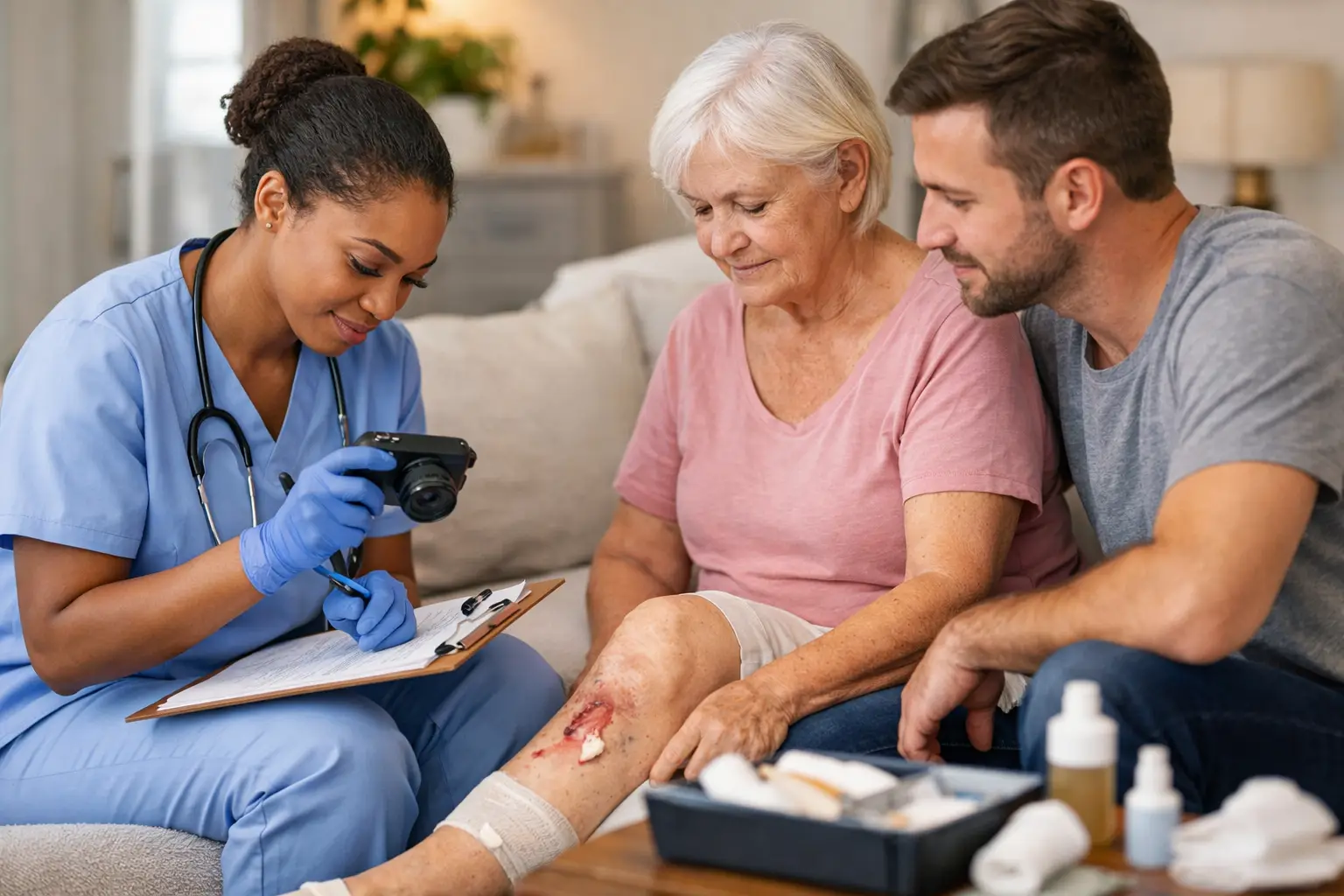
9. Use clinical photographs carefully and with consent
Photographs can support wound monitoring when used within an approved clinical system, with informed consent and appropriate privacy safeguards. They should complement written assessment, not replace it. A photograph may not accurately show depth, odour, pain, warmth or the feel of surrounding tissue.
Use consistent positioning, lighting and scale where possible. Keep images secure and avoid using personal mobiles or informal messaging channels unless this is explicitly permitted under the relevant organisational policy and privacy requirements. Record that consent was obtained or confirmed, and note any refusal.
10. Finish every entry with the next step
A useful wound note answers: what needs to happen before the next review? Record the planned dressing frequency, monitoring instructions, pressure care or skin protection actions, supplies required and the date or clinical trigger for review. If support workers are involved, their role should be clear and within their training, delegation and care plan requirements.
This is where support worker training and clinical oversight make a practical difference. Staff may be able to observe, report, assist with approved routines or identify red flags, but complex wound assessment and changes to the clinical plan require nurse-led judgement. Clear boundaries protect participants and give providers confidence in the care being delivered.
Keep documentation factual, respectful and useful
Good wound documentation is specific without being intrusive. Use respectful language, avoid judgemental comments and record the participant’s preferences, consent and capacity to participate in care. If a person declines a dressing change or assessment, document the discussion, the reason given if they wish to share it, information provided and the follow-up plan.
Avoid copying yesterday’s note forward without reassessment. Repeated wording can conceal meaningful change and creates risk if the record is later reviewed. A short, accurate note based on what was actually seen and done is stronger than a lengthy generic entry.
For participants whose wounds are slow to heal or whose needs are changing, practical nursing assessments can bring together wound findings, contributing risks, care routines and recommendations for the wider team. Compassion Wings provides nurse-led NDIS care across Adelaide, including clear reports for Support Coordinators, clinical care plans and education to help staff deliver safe, dignity-focused care.
The best record is one that enables the next person to act safely: they can see the wound’s trajectory, understand the current plan, recognise what needs escalation and help the participant stay safe at home.





3 Comments
How to Manage Skin Integrity Risks Safely - Compassion Wings
August 30, 2026[…] simple statement such as “skin looks fine” is not adequate clinical documentation for a participant with known risks. Record what was observed, the action taken and whether […]
How to Monitor Diabetic Foot: A Daily Care Plan - Compassion Wings
September 4, 2026[…] Clear documentation turns a daily check into useful clinical information. A simple foot-monitoring record should state the date and time, which foot is affected, the exact location, what was observed, whether there was pain or reduced sensation, and what action was taken. […]
A Practical Guide to Infection Escalation - Compassion Wings
September 9, 2026[…] participant seems off does not give a GP, nurse or emergency clinician enough to act confidently. Clear reporting protects the participant and helps prevent repeated calls for missing […]