






What Does a Continence Nurse Do?
A continence nurse is a registered nurse who specialises in assessing and managing bladder and bowel (continence) problems. For NDIS participants, a continence nurse conducts assessments, creates individualised care plans, manages catheters and continence aids, teaches pelvic floor and bladder-training techniques, and supports carers and families, usually in the comfort of the participant’s own home. In Adelaide, Compassion Wings provides this care as a registered NDIS provider across suburbs including Elizabeth, Semaphore, Marion and Edwardstown.
What Is A Continence Nurse?
A NDIS continence nurse in Marion is a registered nurse (RN) with additional clinical training in bladder and bowel health. They work with people of all ages, children, adults and older Australians who experience incontinence, urgency, retention or other continence-related conditions.
Continence nurses are employed across hospitals, aged care facilities, community health services and private in-home nursing providers. For NDIS participants specifically, an NDIS registered nurse brings this clinical expertise directly into the home, so care fits around daily life rather than requiring hospital or clinic visits.
What Does A Continence Nurse Actually Do?
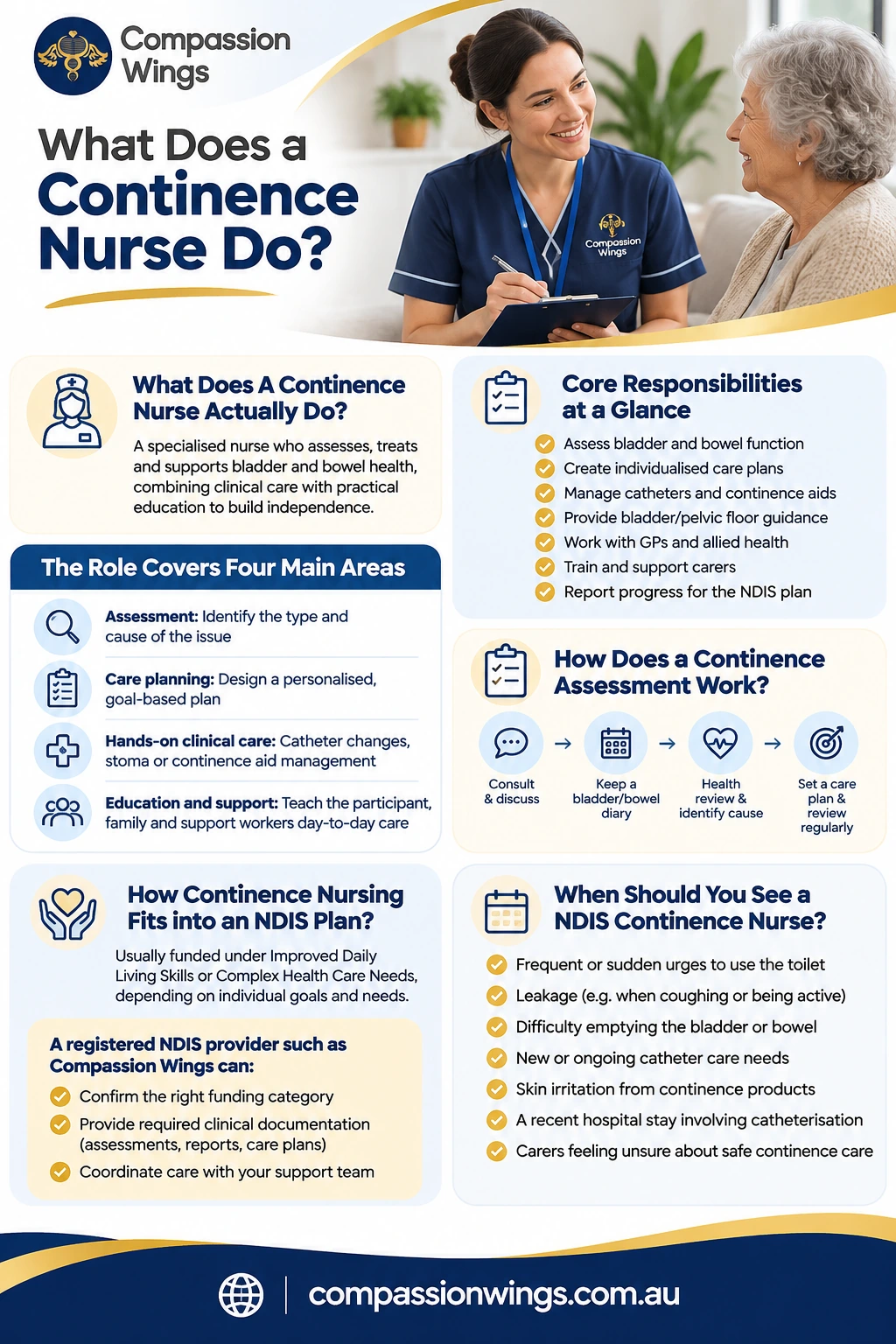
In practical terms, a continence nurse role covers four main areas:
- Assessment: Identifying the type and cause of a bladder or bowel issue
- Care planning: Designing a personalised, goal-based management plan
- Hands-on clinical care: Catheter changes, stoma or continence aid management, wound checks where relevant
- Education and support: Teaching the participant, family members and support workers how to manage continence day to day
This makes the role both clinical and educational. A good NDIS continence nurse in Woodville doesn’t just treat symptoms; they help the participant understand their condition and build confidence managing it independently, where possible.
Core Responsibilities at a Glance
- Bladder and bowel assessments, including bladder diaries and continence history
- Individualised, goal-oriented care plans
- Indwelling, suprapubic and intermittent catheter management
- Fitting and reviewing continence aids (pads, sheaths, toileting equipment)
- Pelvic floor and bladder-retraining guidance
- Liaison with GPs, urologists, occupational therapists and support coordinators
- Training carers and support workers on safe continence care
- Progress reporting back to the NDIS plan and support team.
How Does a Continence Assessment Work?
A continence assessment is usually the first step, and it typically follows a clear sequence:
- Initial consultation: The nurse discusses symptoms, medical history and daily routines with the participant (and family or carers, if involved).
- Bladder or bowel diary: The participant tracks fluid intake, toileting frequency and any leakage over several days to identify patterns.
- Physical review: A general health check to rule out or confirm contributing factors such as mobility, medication side effects or skin integrity.
- Diagnosis of cause: Continence issues can stem from different causes (for example, stress incontinence, urge incontinence, or bowel dysfunction), and the management approach differs for each.
- Care plan development: The nurse sets out practical, measurable goals, such as reducing night-time incontinence episodes or transitioning from full assistance to independent catheter care.
- Ongoing review: Plans are revisited regularly and adjusted as the participant’s needs change.
Continence Nurse Vs Support Worker
NDIS participants often ask whether they need a NDIS continence nurse or whether a support worker can help with continence care. The two roles are different, and understanding this distinction matters for both safety and NDIS funding.
| Continence Nurse (RN) | Support Worker | |
| Qualification | Registered nurse, AHPRA-registered, continence-trained | Certificate-level disability/care qualification |
| Can perform clinical tasks (catheter changes, complex wound care) | Yes | No; requires delegation and training by a nurse |
| Can assess and diagnose continence issues | Yes | No |
| Can assist with routine toileting and pad changes | Yes | Yes, once trained |
| Typical NDIS funding category | Improved Daily Living / Complex Health Care Needs | Core Supports |
| Best suited for | Assessment, catheter/complex care, care plan design | Day-to-day assistance under a nurse-approved plan |
In practice, the two roles work together: a continence nurse assesses the participant and sets the plan, then trains and supervises support workers to safely carry out routine, delegated tasks.
How Continence Nursing Fits into an NDIS Plan?
Continence nursing is generally funded under improved daily living skills or, for participants with more complex clinical needs, complex health care needs support categories. Whether continence nursing is funded and how much depends on the individual’s NDIS plan and the goals agreed with their planner or support coordinator.
A registered NDIS provider such as Compassion Wings can:
- Help participants understand which part of their plan covers nursing support
- Provide the clinical documentation NDIS planners often require (assessments, reports, care plans)
- Coordinate with support coordinators, GPs and allied health professionals so continence care is joined up with the rest of the plan
When Should You See a NDIS Continence Nurse in Port Adelaide?
Common triggers for requesting a continence nurse assessment include:
- Frequent or sudden urges to use the toilet
- Leakage during coughing, laughing or physical activity
- Difficulty fully emptying the bladder or bowel
- New or existing catheter care needs
- Skin irritation or breakdown from continence products
- A recent hospital stay involving catheterisation
- Carers feeling unsure how to manage continence aids safely
If any of these sound familiar, an assessment is a reasonable next step. Continence issues are common and manageable, and earlier intervention generally leads to better outcomes.
Where Can You Access an NDIS Registered Nurse in Adelaide?
Compassion Wings is a registered NDIS provider delivering in-home continence and general nursing care across Adelaide, including Elizabeth, Semaphore, Marion, Edwardstown, Salisbury, Port Adelaide, Mawson Lakes, Parafield Gardens, Woodville and Ascot Park. The service is led by a clinical nurse with over a decade of nursing experience, and every visit is delivered by a qualified registered nurse, not a general support worker, for clinical tasks like catheter management and continence assessment.
Because care is delivered at home, participants avoid unnecessary trips to clinics or hospitals, and support workers involved in day-to-day care can be trained directly by the nursing team.
Key Takeaways
A continence nurse is a registered nurse who provides bladder and bowel health assessments, care plans, catheter and aid management, and education. Unlike support workers, they deliver clinical care. NDIS funding may cover services under health-related categories. Compassion Wings offers home visits across Adelaide suburbs.
Ready to Arrange a Continence Assessment at Home?
Contact Compassion Wings on +61423667551 / (08) 7134 2987, or email haki@compassionwings.com.au / contact@compassionwings.com.au to speak with a registered NDIS nurse about your care needs.
Frequently Asked Questions
What Is the Difference Between a Continence Nurse and a Urologist?
A continence nurse in Adelaide manages day-to-day assessment, education and hands-on care, while a urologist is a specialist doctor who handles complex diagnoses, surgery or conditions that need medical rather than nursing management. Continence nurses often refer participants to a urologist when needed.
Can a Continence Nurse Manage a Catheter at Home?
Yes. A qualified continence or urology-trained nurse can perform indwelling, suprapubic and intermittent catheter changes and care in the participant’s home.
Do I Need an NDIS Plan to Access a NDIS Continence Nurse Adelaide?
Not necessarily. Continence nursing can be privately funded, but for NDIS participants, this care is typically funded through improved daily living or complex health care Needs supported in the plan.
How Often Will I Need Continence Nurse Visits?
This depends entirely on the individual’s condition and care plan. Some participants need weekly visits; others need periodic reviews every few months. The nurse will set this out in the care plan.
Is Continence Care Embarrassing to Talk About?
It shouldn’t be. Continence nurses work with this every day and are trained to discuss it professionally, respectfully and without judgement.
What Suburbs Does Compassion Wings Service in Adelaide?
We provide NDIS-registered nursing across Elizabeth, Semaphore, Marion, Edwardstown, Salisbury, Port Adelaide, Mawson Lakes, Parafield Gardens, Woodville and Ascot Park.