




NDIS Continence Assessment: Which Disabilities Qualify?
Bladder and bowel difficulties can affect a person’s comfort, dignity, independence and ability to participate in everyday life. For people living with disability, these challenges can sometimes be linked to mobility, communication, cognition, sensory processing or neurological function. An NDIS continence assessment can help clarify these needs and identify appropriate strategies and supports. At Compassion Wings, we understand that continence care should be respectful, individualised and focused on the person’s everyday wellbeing.
What Is a Continence Assessment?
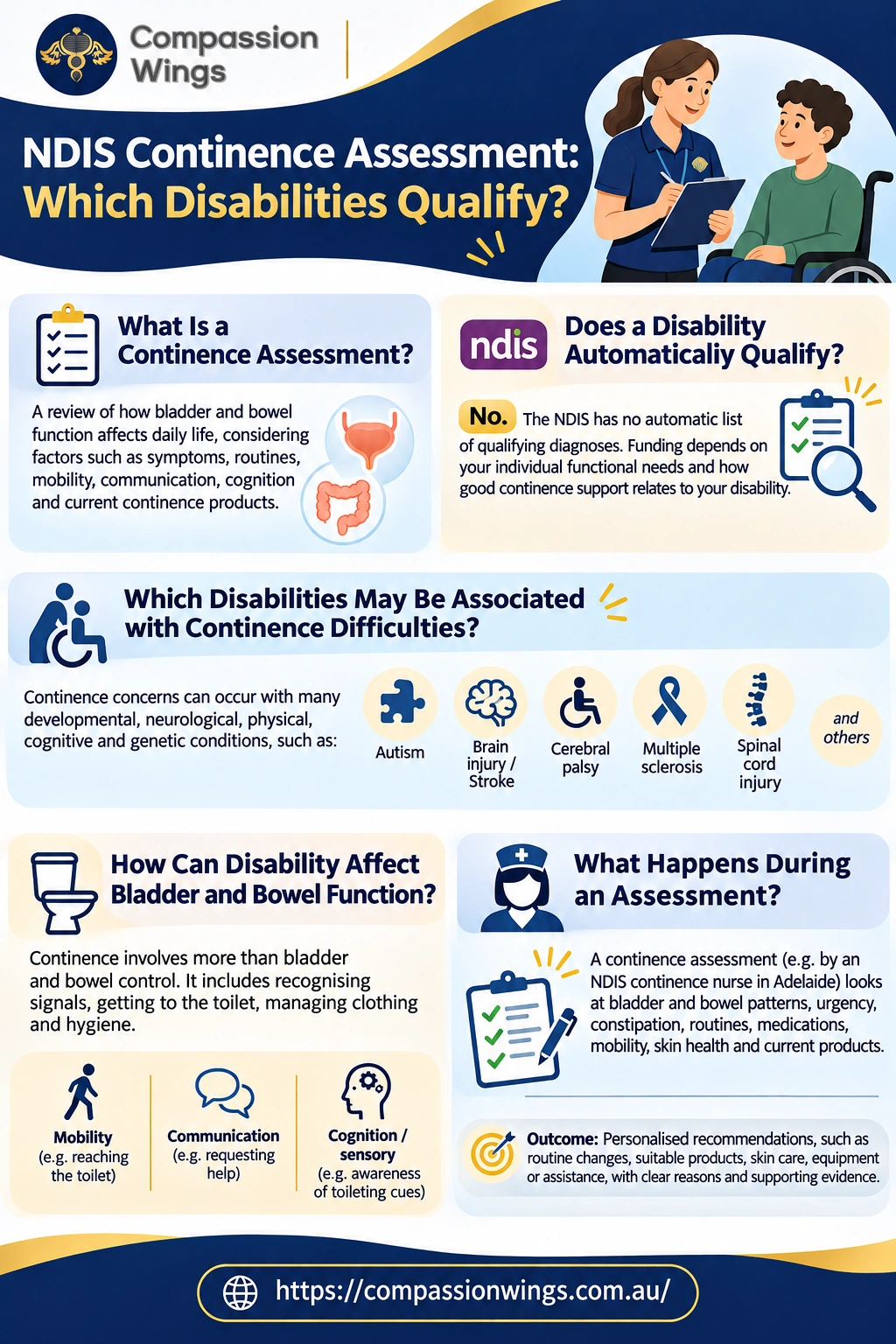
A continence assessment looks at how a person’s bladder and bowel function affects their daily life. It may consider medical history, symptoms, medications, toileting routines, fluid intake, mobility, communication, cognition, skin health and the continence products or equipment already being used.
For NDIS participants, the assessment can also document the functional limitations associated with their disability and explain why particular continence supports may be required. The NDIS states that evidence for a continence-related assistive technology assessment can come from an allied health practitioner or continence nurse.
Does a Disability Automatically Qualify?
No. The NDIS does not provide a simple list of diagnoses that automatically qualify someone for continence funding.
Instead, the focus is on the person’s individual functional needs and the relationship between those needs and their disability. The NDIS may fund disability-related health supports when a person needs help managing incontinence because of their disability, provided the support meets the applicable NDIS requirements.
This is important because two people with the same diagnosis may have completely different continence needs. One person may manage independently, while another may require regular assistance, continence products or specialised equipment.
Which Disabilities May Be Associated with Continence Difficulties?
Continence concerns can occur alongside many developmental, neurological, physical, cognitive and genetic conditions. Examples include autism, intellectual disability, cerebral palsy, acquired brain injury, stroke, multiple sclerosis, Parkinson’s disease, spinal cord injury and spina bifida.
Some genetic and developmental conditions can also affect continence through differences in mobility, cognition, communication, muscle tone or toileting development. Degenerative neurological conditions may create changing continence requirements as functional abilities change.
These conditions should not be viewed as an automatic eligibility checklist. The relevant question is whether the person’s disability contributes to a functional continence problem that affects their daily life.
How Can Disability Affect Bladder and Bowel Function?
Continence involves more than bladder and bowel control. A person needs to recognise bodily signals, respond to them, reach the toilet, manage clothing and complete personal hygiene.
Disability can affect one or several of these steps. Reduced mobility may make it difficult to reach the bathroom quickly. Communication difficulties can make it harder to request assistance. Cognitive or sensory differences may affect awareness of toileting cues or tolerance of particular environments.
Other factors, including constipation, medication, reduced movement and changes in routine, may also influence continence. A comprehensive assessment helps consider these factors together rather than looking at a diagnosis in isolation.
What Happens During an Assessment?
A thorough assessment is centred on the person’s actual experience. An NDIS continence nurse in Adelaide can ask about bladder and bowel patterns, urgency, accidents, constipation, toileting frequency, fluid intake, medications, mobility, transfers, skin health and current continence products.
The assessment may also consider the person’s home, education, employment and community routines. This helps identify where continence difficulties are creating barriers to independence or participation.
Recommendations may include changes to toileting routines, appropriate continence products, hygiene and skin care strategies, equipment or assistance. The assessment should clearly explain the reason for recommendations and provide supporting evidence.
When Can Continence Supports Be Funded?
The NDIS distinguishes between ordinary healthcare and disability-related health supports. It does not fund supports simply to treat a health condition. However, it may fund disability-related health supports that help a person manage a health condition caused by their disability. Continence products are specifically identified by the NDIS as an example of a potential disability-related health support.
For people considering an NDIS continence assessment in Elizabeth, it is important to understand that an assessment does not guarantee funding. Evidence needs to demonstrate the connection to disability, the person’s functional needs, regular daily use and why the recommended support is appropriate.
How Specialist Nursing Can Help
Good nursing care can provide valuable support when continence needs are complex, ongoing or changing. A qualified nurse can assess individual needs, provide education, contribute to care planning and help families and support workers understand appropriate routines.
For participants searching for a “nurse near me”, qualifications and relevant disability experience are important considerations alongside convenience. Continence support should always protect privacy, dignity and personal choice.
Choosing Appropriate Professional Support
When considering nursing services, look for a provider that understands disability-related health needs and takes a person-centred approach. If you are looking for an NDIS continence nurse in Adelaide, consider the professional’s qualifications, experience, assessment process and ability to communicate recommendations clearly.
The right support should focus on the participant’s circumstances rather than treating every continence concern in the same way.
Local Support for Participants and Families
If you are looking for an NDIS continence nurse in Elizabeth, Compassion Wings can discuss your individual requirements and help you understand the type of professional support that may be suitable.
Continence needs can change as a person’s health, mobility, routines or disability-related support requirements change. Ongoing communication with the appropriate healthcare professionals can help ensure that care remains relevant and practical.
Understanding Your Assessment Options
An NDIS continence assessment in Adelaide may be appropriate when continence difficulties are affecting everyday activities, and there is a clear connection with disability-related functional needs.
For participants considering an NDIS continence assessment, professional guidance can help clarify what an assessment involves and what evidence may be useful. The NDIS provides an assessment template to outline the information required, although providers do not have to use the template itself if their evidence contains the required information.
Closing Thoughts
An NDIS continence assessment is not simply about choosing continence products. It helps build a clearer picture of how disability affects bladder or bowel management and what practical support may be appropriate. While a diagnosis does not automatically guarantee NDIS funding, clear clinical evidence can help explain functional needs and support informed decision-making. At Compassion Wings, we are committed to providing compassionate, respectful care services that support greater dignity, confidence and independence.
Let’s Talk About Your Care Needs
At Compassion Wings, we are here to make finding the right support easier. Whether you need continence support or personalised care services, our team is ready to help. Call +61 423667551 or (08) 7134 2987, or email haki@compassionwings.com.au or contact@compassionwings.com.au.
Frequently Asked Questions
What Is an NDIS Continence Assessment?
An NDIS Continence Assessment looks at how a person’s disability affects bladder or bowel management. It may review toileting routines, continence patterns, mobility, current products and support needs to help identify appropriate disability-related continence supports.
Who Is Eligible for a Continence Assessment?
A continence assessment may be suitable for an NDIS participant whose disability affects their ability to manage bladder or bowel function independently. Eligibility for specific supports depends on individual functional needs and applicable NDIS requirements.
What Does a Continence Nurse Assessment Under the NDIS Include?
The assessment may review bladder and bowel patterns, accidents, constipation, toileting routines, medications, mobility, skin health and current continence products. It can also document how disability affects daily continence management and recommended supports.
Is There An NDIS Continence Assessment Template?
While there is no one-size-fits-all template, your continence professional can prepare an assessment tailored to your needs. It may include continence history, relevant charts, product recommendations and practical routines, helping document your needs and support your NDIS goals.
Do You Offer Telehealth Continence?
Telehealth may be suitable for some continence-related discussions, depending on your individual needs and the type of assessment required. Contact Compassion Wings to discuss your circumstances and available assessment options with our team.
How Do I Book a Continence Assessment with Compassion Wings?
To discuss an assessment, contact Compassion Wings on +61 423667551 or (08) 7134 2987. You can also email haki@compassionwings.com.au or contact@compassionwings.com.au.
How Long Does a Continence Assessment Take?
The duration varies according to the participant’s needs and the complexity of their continence concerns. Your clinician can explain the assessment process and expected appointment duration when you make an enquiry.
Will I Receive a Written Continence Assessment Report?
Where appropriate, a written report can document the participant’s functional needs, existing continence supports and professional recommendations. This evidence can help explain the relationship between disability and the requested continence support.
Does a Continence Assessment Help with Funding for Continence Products?
An assessment can provide supporting evidence for disability-related continence supports, but it does not guarantee NDIS funding. Funding depends on the participant’s circumstances and whether the requested support meets applicable NDIS requirements.
What Does an NDIS Continence Assessment Cost?
Assessment costs can vary depending on the professional, assessment requirements and complexity of the participant’s needs. Contact Compassion Wings to discuss your requirements and applicable service costs before arranging an assessment.






1 Comment
What Does a Continence Nurse Do? - Compassion Wings
November 18, 2026[…] participants often ask whether they need a NDIS continence nurse or whether a support worker can help with continence care. The two roles are different, and […]