

NDIS Wound Care Governance for Home Pressure Injuries
A pressure injury at home rarely starts as a dramatic event. More often, it begins with a small area of redness, a change in skin temperature, or a participant spending longer in bed or in a chair because transfers have become harder. That is where NDIS wound care governance for home pressure injuries matters most – before preventable skin breakdown turns into infection, hospital admission, or a major change in daily care needs.
For Support Coordinators, families, SIL teams and participants, governance can sound like office language. In practice, it means something very concrete. It means the right clinician assesses the wound, the plan is documented clearly, support workers know exactly what to do, concerns are escalated early, and the participant receives safe, dignity-focused care in the home. When these pieces are missing, even well-meaning care can become inconsistent and risky.
What NDIS wound care governance for home pressure injuries actually means
In a home setting, wound care governance is the framework that keeps pressure injury care clinically safe and consistent. It covers who is responsible for assessment, how care plans are written, what support workers can and cannot do, when dressings or repositioning routines are reviewed, and how deterioration is identified and escalated.
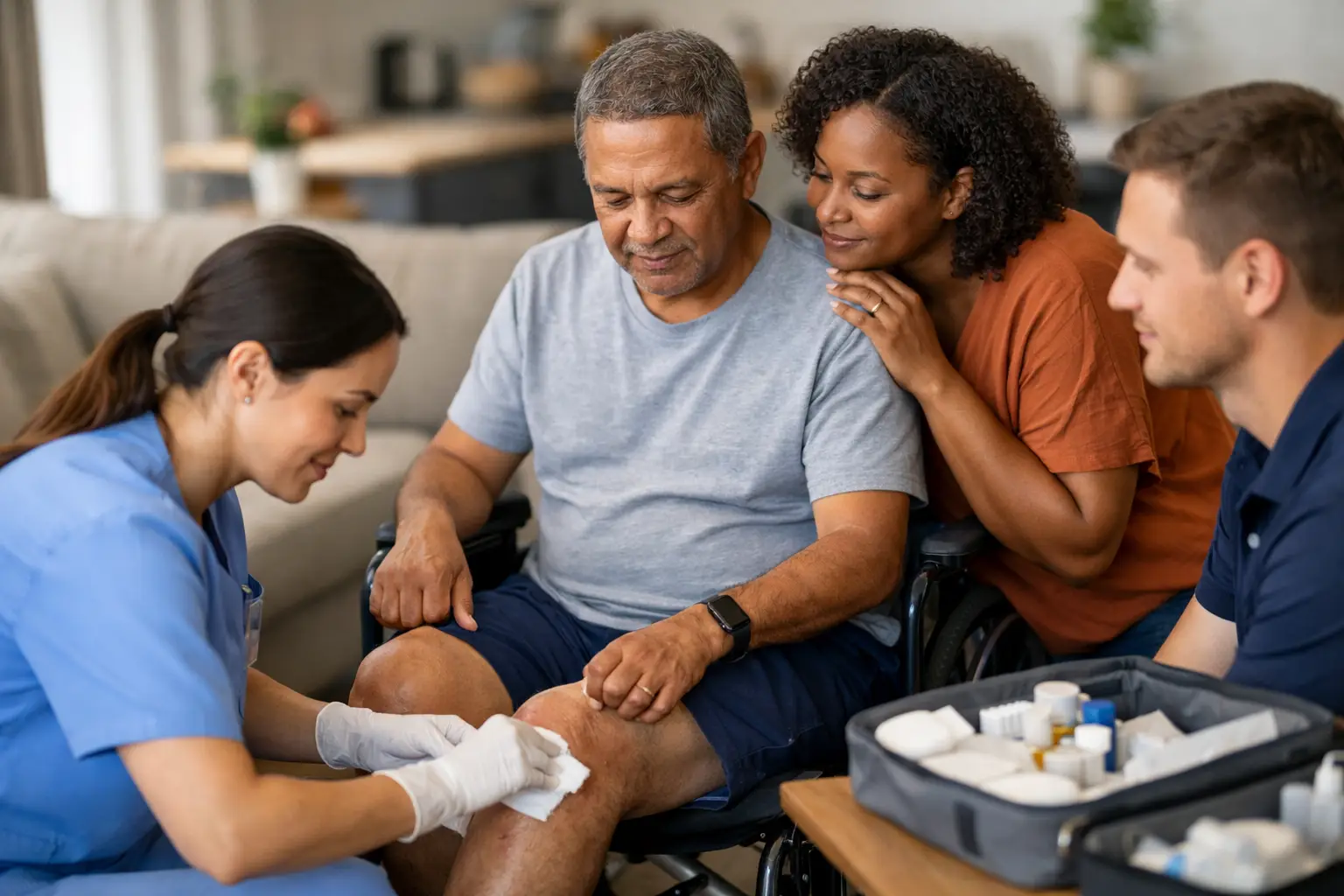
For NDIS participants, this is especially important because care often involves a mix of people. A participant may have family involved, support workers attending at different times, allied health input, a GP, and community nursing or nurse-led NDIS care. Without clear clinical oversight, there can be gaps between what is recommended and what is actually happening each day.
Good governance is not just about paperwork. Documentation matters, but it must reflect real care routines. A wound chart that sits in a folder and is not used by the team does not protect the participant. A practical nursing assessment, a clear care plan, regular review, and support worker training and clinical oversight are what turn governance into safer outcomes.
Why home pressure injuries need stronger governance than people expect
Pressure injuries are rarely just a skin problem. They are often linked to continence issues, reduced mobility, poor nutrition, prolonged sitting, equipment limitations, sweating, friction, shear, or changes in cognition and behaviour. A participant may also have diabetes, vascular compromise, spinal injury, neurological conditions, or a history of recurrent skin breakdown. Each of these factors changes risk.
That is why a dressing-only approach is often not enough. If a wound is managed without reviewing the cause, the same injury may worsen or return. Governance in this setting means looking beyond the wound itself and considering the full clinical picture.
There is also an NDIS-specific reason this matters. Support Coordinators and Plan Managers often need evidence that care needs are complex, ongoing, and linked to disability-related functional risk. Clear reports for Support Coordinators can help show why skilled nursing input, clinical care planning, or additional support worker training is needed to help participants stay safe at home.
Where home wound care can go wrong
Most problems in home pressure injury care are not caused by lack of effort. They happen because roles are blurred or the plan is too vague.
A common issue is inconsistent assessment. One person may describe the wound as a graze, another as a pressure area, and another may not document it at all. If there is no baseline description, no measurement, and no review schedule, it becomes very hard to tell whether the wound is improving.
Another issue is task substitution. Support workers are sometimes expected to manage care that requires nursing judgment, especially when the participant’s needs are changing. There is a real difference between following a clearly delegated routine and making clinical decisions about deterioration, infection risk, or whether a wound now needs escalation.
The third problem is fragmented communication. Families may notice increased pain or odour, a support worker may see more exudate, and a coordinator may only hear about it when the participant presents to hospital. Good governance closes that gap by setting out what needs to be reported, to whom, and how quickly.
What strong clinical governance looks like at home
Strong NDIS wound care governance for home pressure injuries begins with a nurse-led assessment. That should include wound characteristics, skin integrity risks, continence status, mobility, transfer method, positioning routines, equipment being used, pain, nutrition concerns, and the participant’s ability to tolerate or direct care.
From there, the care plan needs to be practical. It should state what the wound is, what care is required, who can perform each part of that care, how often repositioning or skin checks occur, what products or dressings are in use if clinically indicated, and what signs require escalation. In a home environment, clarity matters more than perfect formatting. The plan must be readable and usable by the people providing day-to-day care.
Training is another part of governance that is often overlooked. Support workers do not need a lecture on wound theory. They need practical instruction relevant to that participant – how to complete pressure area checks within dignity-focused personal routines, how to reduce friction during transfers, when to report redness that does not blanch, and what changes in wound appearance should never be ignored.
Review intervals also matter. A participant with unstable skin integrity or a worsening wound may need closer nursing oversight than someone with a superficial area resolving well. There is no single timetable that suits every case. It depends on the wound severity, the participant’s comorbidities, continence management, support worker skill level, and whether the home routine is realistic.
The role of documentation and reporting
Good documentation protects the participant first. It also supports safer coordination across teams. When reports are clear, GPs, coordinators, nursing teams and support staff are less likely to work at cross purposes.
For pressure injuries in the home, records should show the clinical issue, current risk factors, the care plan in place, staff guidance, escalation triggers, and any barriers affecting implementation. If a participant declines aspects of care, that should be documented respectfully and clearly. Governance is not about forcing compliance. It is about making informed decisions, documenting risk, and adjusting support where possible.
This is also where nurse-led NDIS care adds value. Practical nursing assessments and concise reports can help explain why skin integrity risks are increasing, what supports are needed to manage those risks, and why ongoing clinical support in the home is not optional in complex cases.
When Support Coordinators should refer early
A referral to a nurse should not wait until a pressure injury is advanced. Early referral is sensible when a participant has recurrent redness over bony areas, spends long periods in bed or seated, has moisture-associated skin damage, is losing independence with transfers, or has support workers who are unsure about skin checks and pressure care routines.
Referral is also important when there is disagreement between teams. If family members are worried, support workers are reporting changes, or providers are unclear about who is clinically overseeing the issue, that uncertainty is itself a risk factor.
In Adelaide, where participants may be receiving support across multiple services and settings, timely nursing input can prevent avoidable hospital presentations and reduce confusion for everyone involved.
A practical approach for participants and families
For families, governance should feel reassuring rather than bureaucratic. You should be able to answer simple questions. Who assessed the wound? What is the current plan? What should support workers do each shift? What changes mean someone must be called? When is the next nursing review?
If those answers are unclear, the care arrangement probably needs stronger clinical oversight. Pressure injuries can deteriorate quickly, particularly when continence issues, illness, poor intake, or reduced movement are added to the picture.
A nurse-led provider such as Compassion Wings can help bring structure to this process through clinical support in the home, practical care plans, support worker education, and clear reports for Support Coordinators. That kind of oversight is not about making care more complicated. It is about making it safer, more consistent, and easier to follow.
Pressure injury care at home works best when everybody understands their role and the participant is treated with dignity throughout. The right governance approach does not replace compassion – it gives it a safer clinical structure.




1 Comment
Home Nursing Assessment in Adelaide: When to Refer - Compassion Wings
July 29, 2026[…] exudate, infection indicators, dressing suitability and the factors that may be delaying healing. Pressure injury prevention is broader than a dressing. It can include skin monitoring, repositioning routines, moisture […]