

How to Support Stoma Care Safely
A leaking pouch at 8 pm, reddened skin by morning, and a support team unsure whether to change the routine or call for help – this is often when families and Support Coordinators start asking how to support stoma care safely. Good stoma support is not just about changing a bag. It is about skin protection, infection prevention, correct products, clear escalation, and preserving the participant’s dignity every day.
For NDIS participants with complex health needs, stoma care can become unsafe quickly when routines are inconsistent or support workers have not been trained in the person’s specific needs. Small issues such as poor fit, repeated leakage, changes in output or damaged skin can lead to pain, avoidable hospital presentations and real stress for everyone involved. That is why nurse-led NDIS care matters. Safe stoma support starts with assessment, clear care planning and clinical oversight in the home.
What safe stoma care actually involves
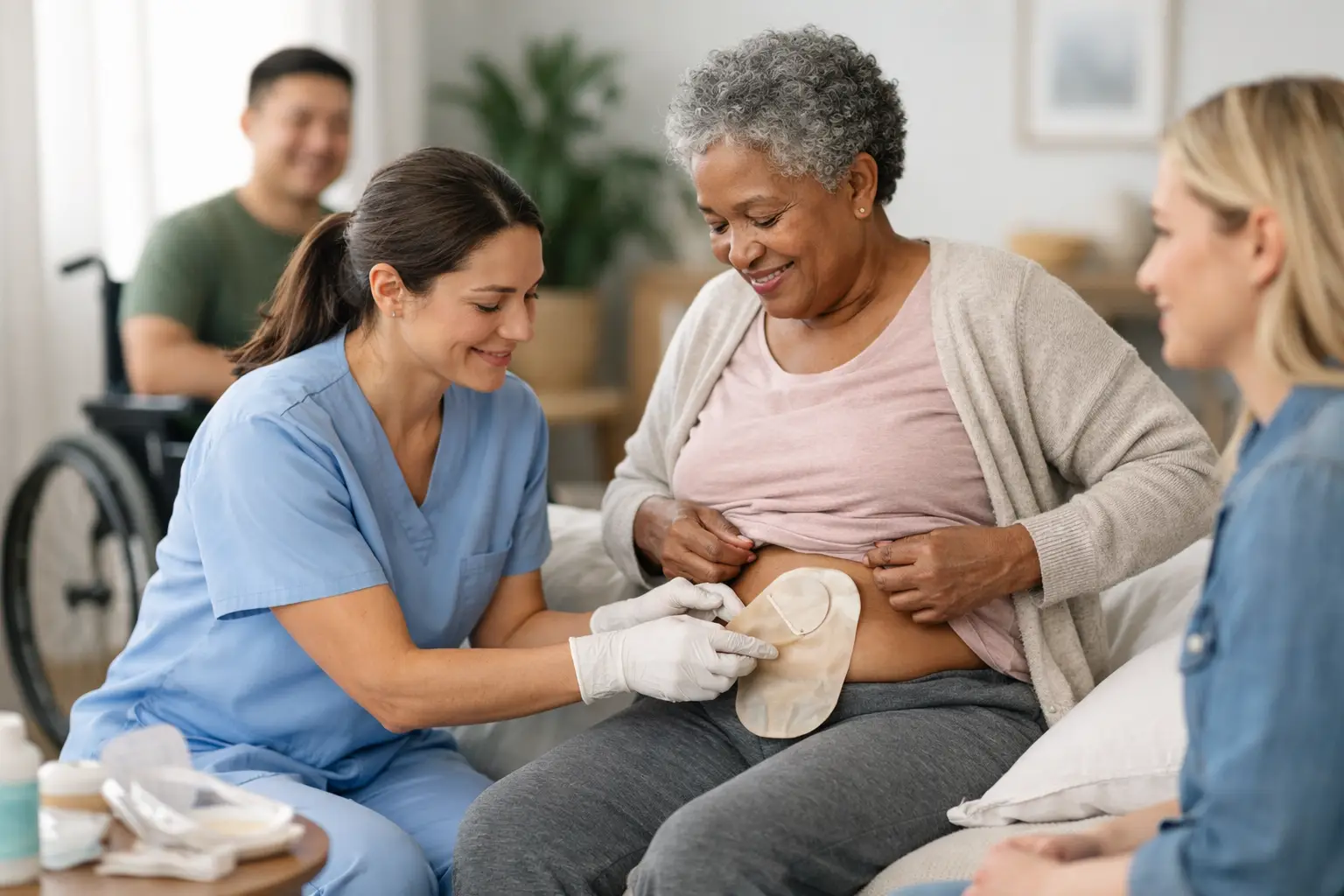
Supporting a person with a stoma safely means more than completing a task. The aim is to maintain a secure seal, protect the surrounding skin, monitor output, reduce contamination risk and help the participant feel comfortable and respected during care.
That looks slightly different for each person. Some participants are independent with most of their stoma routine but need supervision, product review or help when skin problems develop. Others rely on full assistance because of mobility issues, reduced hand function, vision changes, cognitive impairment or other complex health support needs. A routine that works for one participant may be unsuitable for another.
The key point is that safe, dignity-focused care must be individualised. It depends on the type of stoma, the participant’s medical history, their skin condition, their level of independence and who is delivering the support.
How to support stoma care safely in the home
In the home setting, consistency is one of the biggest protective factors. Care becomes safer when the participant has a documented routine that explains what products are used, how often the pouch is changed, what normal output looks like, how the skin should appear, and when concerns need to be escalated.
Before any stoma care, the environment should be prepared properly. Hands need to be cleaned, equipment set up within reach, and waste disposed of safely. Privacy matters here too. A rushed or exposed care routine can undermine trust, especially when the participant already feels vulnerable.
During care, the focus should stay on gentle technique. The old appliance should be removed carefully to avoid skin trauma. The skin around the stoma should be checked each time, not just cleaned and covered. Healthy skin should not be persistently red, broken, weeping or painful. If there is leakage under the seal, that is not just inconvenient – it usually means something needs review.
Correct fitting is another major safety issue. A poorly sized opening can expose skin to output and lead to excoriation. A pouching system that lifts, wrinkles or repeatedly leaks may indicate body contour changes, weight change, hernia development, product mismatch or incorrect application. This is where practical nursing assessments are valuable, because the problem is not always obvious to families or support workers.
Common risks that should not be ignored
The most common problems in stoma care are often dismissed for too long. Mild redness becomes skin breakdown. A small leak becomes a repeated overnight issue. Odour or discomfort gets managed with extra products instead of identifying the cause.
Support workers and families should watch closely for persistent leakage, bleeding from the surrounding skin, ulceration, swelling around the stoma, unusual pain, reduced output, very high output, dehydration risk, or signs of infection. It also matters if the participant becomes reluctant to eat, avoids leaving home, or appears distressed during routine care. Those functional changes often signal that stoma management is no longer working well.
Not every issue is an emergency, but many do require nursing review. It depends on severity, how quickly the problem developed and whether the participant has other clinical risks. A person with fragile skin, poor mobility, diabetes or a history of admission for dehydration may need escalation sooner than someone with a stable, long-established stoma routine.
When support worker training and clinical oversight are needed
Stoma care is one of those areas where informal instruction is rarely enough. Watching someone once or reading product packaging does not replace structured training. If support workers are involved, they need role-specific education, practical demonstration and clear boundaries around what they can do, what they should document and when they must escalate.
This is especially important in SIL and shared support environments, where multiple staff may be involved across different shifts. Without consistent instructions, participants often receive mixed techniques and conflicting decisions. One worker may cut the appliance differently, another may use extra adhesive products, and another may miss early skin damage entirely.
Support worker training and clinical oversight help reduce that variation. A nurse-led service can assess the current routine, identify risks, provide practical education and document the steps clearly. That creates safer handover between staff and gives providers confidence that high-intensity supports are being managed properly.
Documentation matters more than people expect
For Support Coordinators and providers, poor documentation is where manageable problems become ongoing risk. If there is no clear record of stoma type, product selection, usual output, known complications, skin concerns, or escalation pathways, every new staff member starts from scratch.
Good clinical documentation supports safer care and stronger decision-making. It can also be critical when a participant’s needs have changed and further evidence is required for plan review or change of circumstances. Clear reports for Support Coordinators should explain what the current risks are, what nursing input has identified, what supports are required, and why those supports are reasonable in the context of helping participants stay safe at home.
This is where nurse-led NDIS care adds practical value. The goal is not paperwork for its own sake. The goal is documentation that reflects real clinical needs, guides daily care and stands up when evidence is needed.
When to refer for a nursing assessment
Some situations call for prompt referral rather than trial and error at home. If the participant has recurrent leakage, ongoing peristomal skin damage, difficulty managing product changes, suspected infection, changes in output, repeated unplanned presentations to hospital, or a support team that is unsure how to maintain the routine safely, a nursing assessment is appropriate.
Referral also makes sense when the participant is transitioning from hospital to home, when a new support team is starting, or when there has been a decline in function. In those moments, practical nursing assessments can prevent a lot of avoidable disruption.
For Adelaide-based participants and referrers, timely clinical support in the home can be particularly helpful after discharge, when product routines are still being established and the risks are not yet fully understood. A home-based review often shows issues that are easy to miss in a short clinical appointment, including storage problems, transfer difficulties, carer technique, and gaps in documentation.
What a safe stoma care plan should include
A useful stoma care plan should be practical enough for daily use. It needs to describe the participant’s baseline, the approved routine, product requirements, skin monitoring expectations, infection risks, signs that need escalation, and who is responsible for each part of care.
It should also address consent, privacy and participant preferences. Some people want active involvement and verbal step-by-step explanation during care. Others prefer minimal conversation and a predictable routine. Safety is not only clinical. It is also about how care is delivered.
Where support workers are involved, the plan should set out training requirements and documentation expectations. If there are frequent changes to products or technique without nursing review, that usually signals a gap in oversight.
Why a nurse-led approach makes a difference
Stoma care can look simple when it is going well. It becomes much more complex when skin breaks down, output changes, equipment fails, or several workers are trying to follow an undocumented routine. That is where a nurse-led approach makes the difference between managing symptoms and addressing the cause.
An experienced nursing team can assess the participant, review risks, educate the people involved in daily care and provide clinical reporting that is actually useful. For families, that often brings reassurance. For Support Coordinators, it means clearer evidence, more reliable implementation and less uncertainty about whether a participant’s complex health support needs are being managed safely.
Compassion Wings focuses on this kind of practical, clinically grounded support – assessment, care planning, support worker training and clear documentation that protects both the participant and the team around them.
Safe stoma care is rarely about doing more. It is about having the right routine, the right training and the right clinical oversight before a small problem becomes a bigger one.




1 Comment
Nursing Reports Adelaide for Stronger NDIS Plans - Compassion Wings
July 25, 2026[…] without clinical guidance. This may include wound dressing routines, pressure injury prevention, stoma care, catheter support, bowel and bladder management, insulin-related support or complex medication […]